
Foods for sleep
Cooking and science with the authors of Eat Better, Sleep Better
What a treat! I recorded a cooking interview with the co-authors of Eat Better, Sleep Better: Dr. Marie-Pierre St. Onge from Columbia University and Kat Craddock of Saveur magazine. Please cook along with us—one of the recipes is shared below—while listening to the audio or watching the video interview! (For the readers, the transcript is at the very bottom of the page). Please watch or listen for all the details and beautiful foods, but here are the main takeaways.
Top tips for sleep-supportive eating
Eat colorful fruits and vegetables throughout the day. Bananas, oranges, and pineapples have especially been shown to increase melatonin.
Higher fiber, lower saturated fat: a more plant-forward diet will help you with both of these.
Combine a variety of proteins with carbohydrates throughout the day, so that tryptophan (necessary for melatonin production) can reach the brain.
Nuts! Nuts decrease insomnia, contain melatonin, and have healthy fats.
Less sugar. Get carbohydrates from fruits, veggies, and whole grains.
Top tips for making healthy foods delicious and easier
Use flavorful, satisfying substitutions: smoked paprika instead of bacon, smaller quantities of high-quality aged Parmesan instead of loads of cheese and butter
Make ahead condiments, compotes, finished sauces, and toppings for intense flavors and variety ready to go
Fried sage, sumac, nuts, and other textured or distinctively flavored toppings bring delight
Pre-cook and chill or freeze carbs (pastas, rice, etc) so they’re easy to re-heat and the carbs become healthier.
Eat with your eyes and nose first: make your food look and smell beautiful so they taste and satisfy better.
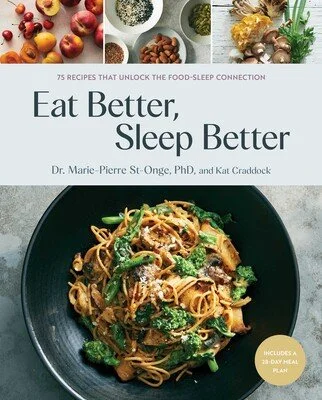
Eat Better, Sleep Better
by Dr. Marie-Pierre St-Onge, PhD, and
Kat Craddock
The cookbook distills sleep nutrition science in an approachable and mouthwatering fashion. The recipes are easy to follow, and there is a 28-day detailed meal-by-meal eating plan that takes away guesswork and makes it easy to eat a healthy, sleep-supporting diet. NPR recently listed it as a Top 10 self-help story of 2025!
Thanks to Banza who provided the chickpea (garbanzo) gemelli pasta.
And a huge thank-you to Dr. St-Onge and Kat Craddock for sharing their time and expertise!
Listen here:
Or watch here:
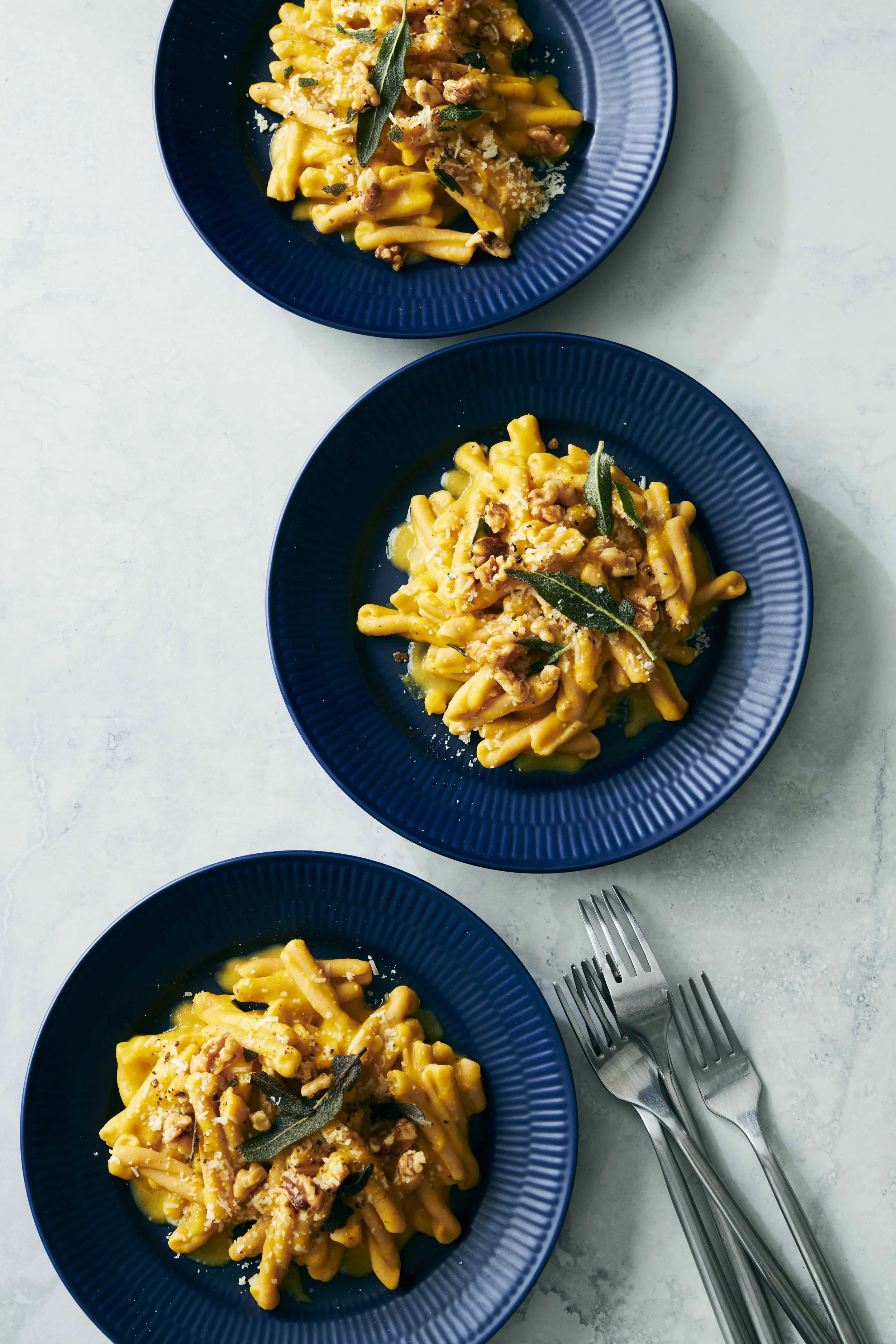
Chickpea Gemelli with Butternut Squash, Walnuts, and Parmesan
Serves 3–4
Total Time: 1 hr.
Kosher salt
8 oz. dried chickpea gemelli or other pasta
1 Tbsp. extra-virgin olive oil
8 fresh sage leaves
One 1-lb butternut squash, seeded, peeled, and cut in 1/2-in. cubes (about 2 cups)
1 small yellow onion, coarsely chopped
4 garlic cloves, thinly sliced
½ cup dry white wine
1 cup chicken or mushroom stock
1⁄3 cup coarsely grated Parmesan cheese
2 Tbsp. coarsely chopped walnuts (optional)
Smoked paprika or freshly ground black pepper
1. Bring a large pot of salted water to a boil, then add the pasta and cook, stirring occasionally, for 5 minutes; it will still be quite al dente at this point. Reserve 1 cup of the cooking liquid, then drain the pasta and set aside.
2. Return the pot to medium-high heat and add the oil. When the oil begins to shimmer, add the sage leaves and cook, stirring frequently, until fragrant and crispy, 2–4 minutes. Remove the leaves from the pot and set aside. To the same pot, add the squash, onion, and garlic, lower the heat to medium, and cook, stirring frequently, until the squash is just tender when poked with a fork, 8–10 minutes. Stir in the wine, using a wooden spoon to scrape up any browned bits from the bottom of the pot; cook until the alcohol has boiled off, 4–5 minutes, then add the stock and the reserved pasta water. Increase the heat to medium-high, bring to a boil, and continue cooking until the squash is very soft, about 10 minutes more.
3. Remove from heat and blend the vegetable mixture with an immersion blender until smooth. (Alternatively, transfer the mixture to a jug blender, blend until smooth, then return the purée to the pot.) Stir in the pasta, return to medium heat, and bring to a boil. Cook, stirring gently, until the pasta is just tender and the sauce is slightly thickened, 2–3 minutes more. Remove from heat and stir in half of the Parmesan. Ladle the pasta into wide bowls, top with the remaining Parmesan, walnuts, if using, and the reserved sage leaves. Sprinkle with smoked paprika or black pepper and serve hot.
Excerpted from EAT BETTER, SLEEP BETTER. Copyright © 2025, Marie-Pierre St-Onge and Kat Craddock. Photography Copyright © 2025 by David Malosh. Reproduced by permission of Simon Element, an imprint of Simon & Schuster. All rights reserved.
Transcript
Yo-El Ju: Good morning. Welcome to Marie-Pierre St-Onge and Kat Craddock. Today we are cooking with the co-authors of Eat Better, Sleep Better. First I'll introduce Marie-Pierre St-Onge, who is a professor at Columbia University. Can you tell us a little bit about your background and what led you to write this cookbook?
Marie-Pierre St-Onge: Yeah, so I have a PhD in nutrition and my research focuses on the influence of sleep, on energy balance regulation, but also the bidirectionality of the association between sleep, obesity, and cardiometabolic risk factors. And a few years ago, I was quoted in the New York Times about some research related to diet and sleep and was approached by our book agent to write a book. And she put me in contact with Kat. She matched us up and we wrote Eat Better, Sleep Better together where I provide information on the science related to sleep and diet and Kat developed wonderful recipes to put all this information into action.
YJ: Great! And then Kat Craddock, can you tell us a little bit about yourself and how you came together to write the cookbook?
Kat Craddock: Sure. Yeah. I am the editor in chief and CEO of Saveur Magazine. I've been with the publication for about 10 years now. Prior to that, I was a French trained chef. So I studied at a French culinary school, Le Cordon Bleu, after college and worked in restaurants as a pastry chef and a bread baker for about a decade before I kind of gradually started moving over to the food media side of things. Now I head up editorial operations at Saveur. I'm also the owner of the publication now. We are a 30-year-old food and travel publication specializing in global cuisine. And we are as of two years ago, a fully independent publication as well.
During the pandemic, Marie-Pierre and I, as she mentioned, our book agent paired us up. I was looking for a cookbook writing project and our agent had a really great idea to match up the two of us. So we spent those weird pandemic days remotely developing these recipes together using Marie-Pierre's science and whatever training I kind of gleaned along the way working in food.
YJ: And I have the least amount of food and nutrition expertise here. I am a complete amateur home cook. So I'm really excited to cook with both of you. I'm a professor of neurology at WashU in St. Louis. I specialize in sleep medicine and I do research on how sleep interacts with neurodegenerative diseases. And right now I'm writing a book and a website targeted to the public, hopefully to help people, especially women, sleep better, feel better, and hopefully age better with good brain health. So I'm super excited.
Let's see, we are going to be cooking a couple different recipes today. So this is—I'm going to show the book—here's the cookbook, Eat Better, Sleep Better. I guess we'll find out if the video got reversed on Zoom. So the first recipe we're gonna be cooking is a chickpea gemelli with butternut squash, walnuts, and Parmesan. And then Marie-Pierre, you are going to make the kale and pita salad. And then I also have a shortbread with banana, a compote recipe, which we'll get going after the chickpea gemelli starts.
So maybe Marie-Pierre, you can start us off with the pasta. So this is a gemelli. It kind of looks like mac and cheese, but actually has butternut squash in it. Why chickpea pasta as opposed to regular wheat pasta? Why would we select a different, bean-based pasta?
MPSO: Yes, we were looking for recipes that were more plant forward because our research is showing that healthy plant-based diets are associated with better sleep quality. And so I think it's important to have a blend of both. You know, we can have whole wheat pasta, but we can also have chickpea pasta that increases the the tryptophan protein content of the pasta. And also chickpeas are a rich source of micronutrients, magnesium, is also very important in chickpeas. At the same time, I'm cutting my kale stems to get cooking for my kale salad.
YJ: And then we have Banza which is a chickpea pasta made just from chickpeas. So Kat, I realize I salted the pasta water. Are we supposed to do that with the chickpea pasta just like for regular pasta?
KC: Yes, yeah, just like you're cooking regular pasta. There are a lot of different brands of chickpea and legume-based pastas. Banza is probably the most widely available. But when it comes to cooking -- we have some cooking instructions in the recipe—we cook it in salted water for five minutes. Always just read the instructions on the box too, just because it's a little less of a consistent product than your standard wheat flour pasta and they may all be a little bit different.
The goal of getting it cooked off first is to cook it until it's al dente. So just barely cooked, still a little bit of bite to it. Also be aware that chickpea pastas tend to cook a bit faster than wheat flour pastas do. This only cooks for five minutes to get to al dente, whereas a wheat pasta might take 8-10. And unlike wheat pasta that has gluten in it and is a little bit stretchier, when chickpea pasta is overcooked, it has a tendency to break down. So you really want to set a timer and make sure that you're erring on the side of underdone rather than overdone with this.
YJ: All right, so I'm setting my timer right now. All right, so five minutes. Okay, and then just in terms of, you know, legumes or beans, Marie-Pierre, can you tell us a little bit about, you know, the combining of proteins and carbs, which you discuss in the book?
What kinds of proteins should we be looking for and why and what kind of carbs should we be looking for when we combine them?
MPSO: We're trying to increase the absorption of tryptophan and transport to the brain, and that requires carbohydrates to be able to transfer other amino acids to the muscle while tryptophan is… while transporters are freed up for tryptophan to travel to the brain for the synthesis of melatonin. Tryptophan is a building block for melatonin. So that's why this amino acid in particular is very important from the diet, because we can't make tryptophan ourselves. We have to get it from the diet. So it's important to have protein rich foods along with carbohydrates. And we're trying to have, as much as possible, more whole grain carbohydrates, more complex carbohydrates.
So carbohydrates that come from whole grain foods, but also legumes and fruits and vegetables rather than simple carbohydrates that we get from the white stuff.
YJ: Okay. So we want to get tryptophan from protein and we want to try to get those from plant-based sources or a variety of sources. And then we need to pair those with carbohydrates, which are hopefully kind of more complex carbohydrates.
MPSO: Correct.
YJ: Okay, things that are brown or have fiber.
MPSO: Exactly. So your brown rice, brown wheat bread, brown pasta, legume based pastas are higher in fiber as well. And we're also looking for the more colorful vegetables because they are rich in polyphenolic compounds, antioxidants and anti-inflammatory compounds that are also very important for healthy sleep.
YJ: Okay, so I think something that's a great takeaway is that foods that are good for your sleep are probably good for your overall health as well. So I feel like there's like nothing good for your sleep that's bad for your overall health. So that's, that's really nice that everything is concordant with one another.
MPSO: It is good for your brain health too: the MIND diet is helpful for your brain and it's helpful for your sleep.
YJ: Great. And then it just in terms of the timing of the tryptophan we get... So obviously a lot of people take melatonin supplements in the evening and stuff. How should we be timing our tryptophan intake? Should we be binging on meat right before we go to bed?
MPSO: Yeah, so we often hear this story about Thanksgiving and falling asleep immediately after consuming turkey. It's not that quick. What you eat has to be processed, has to go through your gastrointestinal tract, right before it travels elsewhere in the body. And that process takes hours. So it's not this quick fix. So to me, my take on this, is to be able to have the nutrients on hand at the ready when it's time to produce melatonin, when it's time to fight infections, when it's time for healthy sleep.
It's just making sure that the nutrients are all available. And also what we eat, the plant-based foods influence our gut microbiome. That takes time. You want to modulate your gut microbiome to have a healthful gut microbiome that produces more short-chain fatty acids that then regulate circadian rhythms and improve sleep. So to me, it's a day-long affair. And that's why we have recipes from breakfast all the way to like good lunch options and dinner options, dessert options as well. So we should be getting our tryptophan and really, you know, a good diet throughout the day.
YJ: Something that my patients ask about is taking melatonin supplements and the best time to take it. The thing is, our pineal glands make melatonin all day, it's just the pineal gland saves up the melatonin and then releases it a couple hours before bedtime. And so we really need to be supporting our sleep and circadian health by, getting all the building blocks available 24 hours a day, as opposed to trying to supplement just at a certain time.
MPSO: Exactly. I'll turn on my oven because I realized I have to preheat to 450 and that's going to take some time.
YJ: Oh yeah. All right. Kat, can you talk a little bit about developing this chickpea gemelli recipe and how you came up with the different combination of ingredients? I don't think I've ever done, say, Parmesan cheese with butternut squash before.
KC: Sure, yeah, I think that one thing that was really interesting to me about putting Marie-Pierre's research into action was that there is such a great emphasis on diversity in our diet and making sure that there are a lot of different ingredients, maybe more ingredients than people could be used to cooking with if they're not regularly cooking. Since I've been working in food my whole career, first in restaurants and then in recipe testing and development, I always just kind of naturally get a lot of variety in my diet and a lot of different ingredients. That's a little bit, maybe a little bit more of a pivot for people to kind of get out there and start incorporating more ingredients into their cooking.
But what I was really trying to do is make sure that even though there were a lot of ingredients and a lot of combinations that we were incorporating into these recipes, that they still kind of scratched that like weeknight easy food fix. You know, this isn't only for mom or dad who may be not sleeping well, it's for the whole family. So everybody needs to be able to kind of enjoy this food. And I didn't want this to be overwhelming or daunting.
So I wanted something that kind of felt like macaroni and cheese, right? Comfort food, winter fare, rib sticking, comforting, carbs, right? We all love that kind of food. I have a background in cheese as well. Before I went to culinary school, I wanted to kind of be able to incorporate the flavor of cheese without all of the nutritional hazards that might come with it sometimes. So the color, obviously a butternut squash came to mind first. And I played with it a little bit, incorporating it with some of those savory flavors. I tried it with miso. I tried it with fermented black beans. But really at the end of the day, a little bit of Parmigiano Reggiano or good quality—there are a number of other similar cheeses, American style Parmesan or Grana Padano, which is another classic Italian grating cheese--they're so flavor dense that you really don't need a lot of it. So when I developed a recipe for a sauce that kind of got at that macaroni and cheese consistency, going with a really aged cheese like that and incorporating it into something a little bit sweet, a little bit starchy, really got at what we were trying to accomplish with that flavor.
This is a recipe that comes together in one pot. I’m doing it in two just to keep things moving a little bit quickly here, but I also wanted to make sure that this was not something that was going to take over your whole kitchen. Takes a little bit of time to prep, but all of the ingredients are [easy to prep]. I actually tested this out for this shoot. I wanted to see if I could get everything pretty easily already prepped out from the grocery store. I was able to get cleaned and cut squash all ready to go. I was able to get onions pre-chopped. You can either get them in the produce section or in the freezer section.
The one thing that I would recommend people do not cut corners on though is getting pre-grated cheese for this. Pre-grated cheese is totally fine for topping for a lot of different uses, but frequently, pre-grated Parmesan has some anti-caking agents, preservatives, things like that to keep it longer in the fridge and keep it from clumping. And those ingredients will kind of prevent it from melting nicely into your sauce. So I would recommend getting a hunk of Parmesan, whether it's Parmigiano Reggiano or BelGioioso -- that's an American brand that's pretty widely available and really reliable as well. Get the hunk, grate it yourself, and you're going to see a much smoother, silky cheese sauce using it that way. It's so easy to grate cheese directly. It's not like, you know, you don't save much time by just buying pre-grated cheese, in my opinion.
KC: Yeah, and I find it does last longer in the fridge too. A hunk of parmesan if you wrap it well, it's going to keep a lot better than the pre-grated stuff that has a lot more surface area to it.
YJ: Yeah, I also feel like food tastes better if you can kind of taste it with your eyes first, you know, to like see the cheese being grated. It just like makes you so hungry for it. I feel like that's like the best part of any dish: the ceremonial cheese dusting. And then Kat, you had mentioned that this is a recipe that could potentially be made ahead. So how would we modify the recipe if we wanted to make it ahead?
KC: Yeah, that's actually, it's a great idea that I think it works beautifully this time of year when you, know, potluck season or if you're feeding a big, if you're doing a big Thanksgiving or holiday meal. If you multiply this by 3 or 4 depending on the size of your pan, it works beautifully in kind of a big baking dish. did it in a big lasagna pan. It's in the oven right now. I can show it to you guys in a little bit. But if you just kind of multiply it by 3 or 4, tip the whole pasta into the roasting pan and put the cheese on top and throw it in the oven. It's like a big baked macaroni and cheese, right? And it works as a good side dish. It works as a main because it's much more protein-rich than wheat flour pasta.
So it's certainly impressive and it has the same kind of oven to table “Wow!” moment that a big baked macaroni and cheese would have as well.
YJ: So for that, would you make the fried sage leaves later and just add them on at the end or do they freeze okay? Yeah, I would make the fried sage, well, make the fried sage the same way you normally would, but don't put it on top of the pasta and don't put the walnuts on top of the pasta until it comes out of the oven, because they're more likely to burn in the oven. But you do want to fry the sage leaves ahead of time, which I'm going to do that right now. Because getting all of that beautiful sage flavor into the olive oil, I think really kind of elevates the macaroni and cheese and makes it good for grownups as much as it is good for kids. Sage, fried sage and butternut squash combination is very classic. It's very easy to do.
Just dropped a few sage leaves into hot olive oil. don't know if you guys can see it in there, but as soon as it goes into the pan, it just fills your kitchen with this beautiful, beautiful herbal aroma. And it's a very impressive kind of flex to top your pasta with frizzled delicious bright sage leaves at the end. Yeah, it smells so good right now. I'm doing my sage leaves.
I drained my pasta and now I'm doing the sage. And once that's done, then I guess I'll take those out and everything gets put back into the same pot, which is great. I'm going right in with my pasta now. Even even now I still set a timer. just encouraging everybody. It's not cheating. Do set a timer. Don't walk away from it. All right.
YJ: And then the other recipe I'm making, I made ahead. So let me see. Let me find my recipe.
This was a banana chamomile shortcake. And this is a recipe with biscuits that are super quick and it has oats in it. It has oats, whole wheat flour as well as all-purpose flour. And it's really easy because it has olive oil as opposed to using butter that you have to cut in. So it actually makes it a lot easier to use the healthier fats.
I made them ahead. I'm going to go grab them just to show them off.
MPSO: Can't wait to see those.
YJ: Yes, I haven't baked them yet. So this is a pre baked.
MPSO: Nice.
YJ: So I made 13 biscuits, not 12, but I wasn't going to start over. I'm to pop these in the oven now. Hang on one moment.
KC: The thing I love about that recipe too is you know, classic rolled out southern style biscuits. They take a lot more kind of skill and finesse and you don't want to overwork them too much. These are a drop biscuit. So you really can't mess it up. You just mix everything in a bowl and then scoop plop it and scoop it and plop it right into your, your cooking pan.
YJ: Yeah. It was so easy. I have like the, you know, the, the cylindrical shaped measuring cups. I just plopped em in. So that was super easy. Let me get myself organized here. How do you know when the sage leaves are done?
KC: You'll see them sort of getting a little bit darker not browning but they almost start to look a little bit translucent, I would say.
YJ: Okay.
And they'll be crispy, crispy and you don't quite want to get any more color on them than just that sort of like translucent the darker green. But once they're crispy, you can pull them out and set them on a little paper towel. You can make those ahead of time for sure.
MPSO: It does start to curl a little bit, no?
KC: Yep, they curl up a little bit. usually try and flatten them down a little bit with my spoon or whatever I'm using to scoop them out so that they get evenly crisped.
MPSO: The chickpea gemelli recipe is one of the two recipe rotation in my household because I absolutely, absolutely love squash, all squash. And the soy braised miso butternut squash is a recipe that I make pretty much every week during the fall, winter when it's squash season.
The butternut squash are always bigger than you expect them to be. So one squash to me gets me one recipe of just a butternut squash side dish. And then I use the other piece to make the chickpea jam. Wow.
YJ: Yeah, I have like half the squash left over. I forgot, like we should probably wear gloves at least one hand to cut butternut squash because you know like the orange flesh kind of stains your flesh and you have to scrub it off. So I've forgotten. I need to get back into squash eating mode this season.
KC: I should also mention that and the recipes is butternut because that's the most widely available all-year-round winter squash. But you can really use any winter squash for this dish. I'm using delicata right now because they were at the farmers market and beautiful. And butternut squash, usually, especially the really big ones, the skin is quite thick and you're definitely going to want to peel that with a vegetable peeler. The smaller butternut squash or any smaller winter squash like delicata, I've just been leaving the skin right on there. I'll cut them in half, stick everything out and cut the stem part off. But the skin is so thin that it'll blend up beautifully. And I don't know, Marie-Pierre, you can weigh in if there's more nutrition in the skin or not, or more fiber.
MPSO: But I never thought that the, never knew that the butternut squash skin was edible. I always, always peel it off. And, and I always liked that kabocha squash and acorn squash and those delicata squash that you can eat the skin. I love that, but never thought of, I thought that butternut squash because of the, I don't know the waxiness of it. You couldn't really eat it.
KC: Yeah, I would say the big big ones, it's probably going to be too tough. But sometimes you see the little baby butternuts. No, I've eaten those no problem. I've blitzed it into a soup. Maybe some of the ones that are I think sometimes at larger supermarket chains, they may wax them a little bit. And if it feels like there is actually wax on the outside, I just run that under hot water and give it a big scrub to remove it. But the skin is yeah, and it's not really that much different than a zucchini. They just leave it on the vine a little bit longer.
MPSO: I see.
YJ: Let me wait for Marie-Pierre to come back.
MPSO: My oven's ready, so I'm going to... okay.
YJ: Yeah, pop things in.
MPSO: This is like my one sheet pan of vegetables for the warm pita salad. Looks great, right?
YJ: That looks beautiful.
MPSO: Yeah, I'm gonna. Alright, so now this is 20 to 30 minutes. 20 to 40 minutes.
YJ: So I took out the sage leaves and now I'm cooking the onions, garlic and the butternut squash that's been and So I guess we do that for maybe eight to 10 minutes before we mash them all up.
KC: Yeah, and if you notice your onions start browning before then, you can cut this step a little bit shorter and just cook the squash longer once the liquid has been added.
My onions, my pan was maybe a little hot when I put the vegetables in and the onions are starting to caramelize. I don't want to get too much color on this because I still want to retain that nice golden orange color in the finished sauce. So I'm going to go right in with my wine right now. And Marie-Pierre do you want to talk a little bit about the wine that we've incorporated into a lot of these recipes. And I know that that you mentioned that there might be melatonin in that as well.
MPSO: Right. Yeah. So some wines and grapes, there's some melatonin. So some wines could have melatonin. There's also lot of polyphenols, mostly in the red wines. So we've been incorporating wine, also beer actually--in one of the muffin recipes, we use a stout. So they've been shown to have a lot of polyphenolic compounds, also melatonin. We've been including those in the recipes. It [the heat] kind of burns off the alcohol and you get the benefits of the polyphenolic compounds and melatonin.
YJ: Kat, what should be used for the flavor for the people who don't drink alcohol or don't have it around?
KC: Yeah, this recipe uses a dry white wine. I had a holiday party a couple days ago and I had some leftover bubbles in the fridge, so I actually put Prosecco in there. But you want to make sure it's not a sweet wine. You can also absolutely, if you're not an alcohol drinker, you can buy cooking wine at the grocery store. Just be aware that it has a lot of salt added to it to make it shelf stable.
So you're gonna wanna dial back the salt in the recipe and then just season to taste at the end so that you're not over seasoning.
YJ: I don't have any open wine, and I generally don't drink wine. So I have vermouth that I keep in the fridge, because you don't wanna keep like a half open bottle of wine. So I'm gonna [use vermouth].
MPSO: Kat, does it matter when you're cooking with wine? If it's an old bottle of wine, if it's, you know, stayed on your counter for a couple of weeks like you wouldn't drink it. But if you could cook with it, is that...?
KC: I would give it a sniff. If it has turned to vinegar, I wouldn't use it in the place of wine. And I usually will keep it in the fridge if I'm not going to drink it right away. I'll keep it in the fridge just knowing that I'm going to want to cook with it. But yeah, I mean, this is not the best bottle of wine that you want to open up to put in your macaroni on a Wednesday night. If you've got leftovers, great. You can pack it out into little kind of plastic containers and throw it in the freezer too if you're not moving through it quickly enough.
Fortified wines like vermouth will last a lot longer because they have some brandy added to them. So that is a preservative as well. I still keep my vermouths and port and fortified wines like that. My mom and dad always kept port in the liquor cabinet indefinitely. I wouldn't recommend that. I would keep it in the fridge just to keep it a little bit longer. But yeah, I mean, if it's been around for a few days, you're still fine to cook with that. Good to know.
YJ: Marie-Pierre, what kind of micronutrients or macronutrients are in squash in general?
MPSO: Squash is high in vitamin A. A lot of it has magnesium, vitamin B6, potassium, lot of potassium. So those are good, good micronutrients. So we're supporting sleep, vitamin B6, magnesium and zinc are relevant for conversion of tryptophan to melatonin. And they've also been shown to be associated with better sleep quality.
YJ: Are there certain squashes that are better than others?
I don't know. There might be some small differences between different squash. But to me, I feel like the darker orange colored squash, pretty much you can count on them having vitamin A and a lot of polyphenolic compounds.
YJ: Yeah, I feel like it's a nice shortcut. Just the more colorful stuff is generally better for you.
Kat, I wanted to ask about what are some tips to make healthy food more appealing? So I feel like it's always great when we can plan ahead and make healthy foods. But at the end of a long work day, it's a lot easier just to take out or make mac and cheese from the box. If we do take the time to make healthy food, how do we make it like taste as good and as appealing as something that's easier?
KC: I love this question. Like I mentioned, I have a French culinary training background, and I'm very used to cooking with a lot of bacon and cream and butter and a lot of things that maybe Marie-Pierre wouldn't recommend consuming the quantities that I'm used to cooking with. So as we were developing these recipes, we kind of went back and forth a little bit to try and figure out how to achieve those sort of same satisfying effects while having a more healthier outcome.
For example, bacon is an ingredient that I like to use in moderation, but pretty regularly. And it didn't necessarily add much to a lot of what we were doing. So instead of that, we decided that we were gonna start swapping in more olive oil and smoked paprika, which is an ingredient that's used in Spain. It's pretty widely available at well-stocked grocery stores or there are a couple of single origin spice companies that I really like. This is a flavor that really brings that kind of rich smokiness to a dish. Whether it's a clam chowder or macaroni and cheese, something where you might want that kind of bacon flavor to it without adding, and it's really just smoked ground red peppers.
So this particular dish, you can finish it with black pepper at the end. I really like to sprinkle a little bit of smoked paprika on. It gives it little bit more color. You eat with your eyes and your nose before you eat with your mouth so that that kind of fragrance and visual appeal is really, -- I think it really adds a lot to the experience.
We also have a whole chapter in the book of kind of make ahead pantry stuff. And if you spend maybe a Sunday afternoon work working through a couple of those dishes, there are some kind of condiments and toppings and finishing sauces that keep well either in your pantry or in your refrigerator so that when you do come home starving at 730 or 8 o'clock at night, you really need to get something healthy on the stove and in your stomach fast. Having some of those things made ahead of time and you really just do need to boil some pasta or cook some rice or just do the kind of last little bits that having those, having some of that heavy lifting done ahead of time really makes a big difference.
YJ: Something that I was really pleased to find out is that chilling or cooling down carbs makes them healthier. So for example, like plain white pasta or white rice, if you cook them and then you let them chill in the fridge overnight, or if you freeze them, then they actually kind of take longer to digest in your system and they spike your glucose less. So that's vgreat for me, because I like to cook those types of things ahead of time and freeze them. And that way I can just microwave them when I need them. So I think that's like a healthier way of eating that actually makes life easier in terms of how long it takes to cook.
All right, how do we know when to blitz this? I think mine needs to go a little bit longer before I blend them.
KC: I would give it a poke with the tip of a paring knife or a fork. And if it's tender, if it slides right off, then it's ready. And if it's still kind of firm, like a hard potato, keep going. And if you're losing liquid, if it's boiling off before the squash is soft, you can always add another splash. I don't know if you noticed that when I was draining the pasta, I reserved a cup of the pasta water. So that goes in there with some vegetable, with some broth. I call for either mushroom or chicken, but any stock you have around works just fine. That pasta water, there's a bit of starch in there that will help kind of bind the sauce a little bit, keep it from separating, keep it silky and smooth and help it cling to the pasta. So that stuff is gold. Don't dump it all down the drain, save a little bit of it. But if you need to add a little bit more tap water, that's totally fine. I think I'm actually going to do that a little bit because my squash was cut kind of large.
YJ: So even with the chickpea pasta, there's starch in the pasta water?
KC: Yes.
YJ: Oh ok. How long did it take to develop all the recipes and the science? What was the process for getting all of this together into the final product?
KC: I'll let Marie-Pierre speak to the science, maybe her whole career, probably.
MPSO: The science takes a long time. Writing it up is, you know, it took time too, but getting the science always takes a long time, right? Doing the research is what really takes time. writing the book took a few years. yeah, it took some time developing the recipes, testing them. Kat tested all of the recipes you know, to make sure that they were all proper, you know, with proper quantities and ratios. And then I tried them at home as well. I had my kids, my husband taste them, get their feedback, try to see how would a person who's doing this at home be able to do it? Is it something that we could do?
Like we were talking about, you know, coming home from work or ... or are those recipes too involved? And it was great because, you know, I could say confidently that a lot of the recipes, you know, although Kat was saying have a lot, seem to have a lot of ingredients, they're not very hard to put together and relatively quick to assemble for dinner. And there are some that are longer and they're more, you know, we keep them for the weekend. And often those recipes make a big batch. And thankfully you have leftovers for the rest of the week.
KC: Yeah, we haven't really talked about your meal plan, Marie-Pierre. I think that's an interesting topic to kind of delve into a little bit with that in mind that we did really kind of develop a schedule of how people can incorporate these recipes into a month's worth of eating, including using up their leftovers and not eating the same thing every single day because that's a really good way to burn out your palate and make you not want to continue eating this way.
YJ: Yeah, I do love that section that has, I think it's a 28 day eating plan where it just tells you day by day kind of what to eat and how to combine the different recipes so that you're getting novelty as well as a good nutritional balance. Marie-Pierre, how did you kind of balance out the different macronutrients, the different recipes, over those 28 days?
MPSO: Yeah, so all of the recipes, I actually ran them all through NDSR. It's Nutrient Database software for research where I knew the whole nutritional composition of each of the recipes down to its amino acid profile, different fatty acid profile, all the micronutrients that we're talking about. And then when I put together the meal plan, kind of assembled the recipes in such a way as to maximize how much tryptophan, magnesium, vitamin B6, zinc, fiber there would be in a single day and try to go at it that way. Because some recipes are higher in one nutrient than another. so mixing them in that way would maximize the proportions. And also thinking about, which are the recipes that take a little longer that could be done on the weekend and then that would have leftovers that you could use for lunch on a weekday or for dinner on a weekday for pre-preparing breakfast for the week or things like that. So that's how I kind of put it all together.
YJ: What would you recommend for the vegetarians or vegans? What are the plant-based protein sources that we should be looking for and combining? What are some easy swaps to do for the recipes?
MPSO: Yeah, so we have a different list of foods in the book that show which ones are higher in tryptophan and different vitamins, serotonin, melatonin, as well. But, you know, you could use some tofu in place of in place of some of the meats. When I was testing some of the recipes at home, my daughter wanted to be vegetarian for a year. At that time, think she was 12, around that age. And she said, I'd like to try to be vegetarian for one year. I'll start on January 1. So that way I know when my year starts. I was like, OK.
So there was a recipe that called for, one of the recipes I think calls for sausage, I think in the stuffed tomatoes, and for her I swapped it with tempeh. And so Kat, I don't know, you might wanna talk to different swaps that you can make for different recipes also that make it more vegetarian friendly.
***wifi woes***
YJ: Kat, we were just saying how the pita and kale recipe, it's one pan. This, the gemelli recipe, is one pot. And then the shortcake recipe also I made in one bowl where you know the wet ingredients were just added to the dry ones. So these are all great recipes. One less big bowl to wash.
KC: Yeah, working in professional kitchens, you get really used to having somebody else that does your dishes for you all the time, which is a real blessing.
I don't have that at home. I do have a dishwasher machine, but yeah, as much as we can streamline and as little dish, as few dishes as possible, it was definitely a goal here as well. We don't need to create more work and more anxiety and clutter for anybody with this project.
YJ: Kat, are you ready to blend?
KC: Yes, I was just gonna say, while I was working out my technical difficulties, I turned the stove off because this squash is nice and soft and ready to go.
I have a stick blender, which I use all the time. I like pureed soups a lot. So these are super duper handy. I particularly like this one because it's got a removable blade that's easy to clean. But I have it plugged in right next to the stove. I turned it off because we don't want it actively cooking while we blend. if you have an outlet by the stove, I find it just as easy to leave it there and not worry about moving it around. So this is going to be noisy for a minute. Excuse me.
YJ: All right, and then I'm going to blend too, so I'm going to go on mute.
KC: If you don't have a stick blender, a regular jug blender is totally fine for this. If you don't have extra appliances, you can also really do this with a potato masher and just leave it a little bit more shaggy and coarse. But if you want that nice silky consistency, blending it either with a stick blender or a classic blender will do you right.
I don't love this in a food processor. I find that it's too liquidy for something like that and they have a tendency to splash over the edges.
MPSO: All right, I'm all done with my recipe. The warm pita salad with kale, feta, tomatoes, and chickpeas. I think it came out nicely. I love the brightness of the greens here. There you go. Kat, I'm very proud of myself on this one.
KC: And then once that puree is nice and smooth, if you want to be really chefy about it, you can run it through a fine mesh sieve. We didn't do that. It's not necessary at all. And then I already have my pasta already cooked. So I add that to the sauce and turn it right back on to bring it up to a boil once more.
MPSO: Yeah, that sauce comes a lot comes together very well. It doesn't it's not runny or anything like that. It really is very creamy.
KC: Yeah, and if you're making a large batch and baking it and you want to reserve that kind of creaminess and not have it be like a dry baked macaroni and cheese, you can add another half cup or so of water. Just adjust the salt and pepper accordingly.
YJ: All right, I can unmute now. I love using the stick blender, but it was very noisy. All right. so let's see. after we blenderize then we put all the pasta back in, right?
KC: And mine is already starting to bubble again. It doesn't need to be a big rolling boil. It's not a ton of liquid in there, but it's once you see it a little action in there again, you're ready to go. And then you put half of your grated cheese in. A few tablespoons. I like to turn the heat off at that stage so the cheese melts a little bit more gently. Give it a taste, make sure that the seasoning is to your liking. that's so good. Do you want to talk a little bit about salt, Marie-Pierre? And we're a little bit kind of we season to taste a lot. not being really scientific with the quantities of salt and everything.
MPSO: When you cook at home, there's really very little salt in your, in your dishes because it's all fresh ingredients, hopefully. So you usually season to taste. You know, and salt is one of those, it's an acquired taste. And so you can cut down on salt…[Looking at baked shortcakes] those look very beautiful. They're nice…You can train your palate to eat less salt. And, using other spices can also be very useful to compensate for less salt in your cooking. So I think it's good to cut down on salt as much as possible, but salt does amplify the flavor of various dishes. So you don't need to put a lot, just a tiny bit and then compliment with other spices.
YJ: I have heard from a lot of my patients now who are taking GLP-1s that their ability to taste the salt has improved where... or they didn't realize how salty their foods were, especially when they ate out. And now they're like, wow, that is overpoweringly salty. So it's interesting how that class of drugs really changes the perception of taste.
MPSO: Yeah, I wasn't aware of that. Interesting. I'm sure it does the same for sugar too, right?
YJ: Yeah, I think so. But also, I feel like people kind of know that there's sugar in sweet treats, whereas, you know, it's gonna be…
[looking at Kat’s gemelli plated] Let me se, Kat, can you show it again? Oh, beautiful!...
Whereas people aren't always aware of how salty their savory foods are.
All right, I need to find my cheese. There we go. So we put half the cheese in, but after we take the heat off, right?
KC: Yes, yeah. Bring it back up to a boil with the pasta in there, then turn the heat off and stir in half of the cheese. And I put the smoked paprika, but I really like black pepper too, so I'm going to put a little bit of that on mine
MPSO: I love that the kale salad has sumac. I love sumac. It's such a wonderful spice.
YJ: What is Sumac?
KC: It's a berry that it grows on a tree. Different from poison sumac, kind of it's a tree like poison sumac, but it's a edible berry that grows. It's a red berry. It's used in Persian cooking a lot. And it's got kind of a bright lemony flavor to it. You can use it in place of lemon or you can, if you don't have sumac, can use lemon juice as well. But sprinkled over sweet or savory dishes, I like it. It adds a really kind of nice bright pop that can be, yeah, if you're trying to get more flavor in without adding more salt, I think that kind of brightness can really bring a lot to a dish. Great.
YJ: So for the pasta, we put into wide bowls, top with the remaining Parmesan and walnuts. Oh, let's talk about nuts! Marie-Pierre, tell us about nuts and why they are so good for us.
MPSO: Yeah, nuts contain melatonin and a lot of polyphenolic compounds. So walnuts actually are being studied now as a food that can increase melatonin levels. But there are other nuts, pistachios. I'm actually on the the board for the American pistachio growers. They're rich in polyphenolic compounds, phytomelatonin. They contain tryptophan. They have vitamin B6, magnesium. Studies are showing, actually we just published a paper showing that consuming a diet that's higher in, or that's closely aligned with a Mediterranean diet, but also dietary approaches to stop hypertension are associated with reduced risk of insomnia. And when we're looking at specific components of the diet, nuts are associated with lower risk of insomnia. Definitely adding nuts to the diet that I think, you know, in the US nuts are not consumed very widely, but in other cultures, very much so. And also they add a little bit of crunch to to the foods that you eat, it helps to also make things a little more satisfying, healthy fats, polyunsaturated fats, and lower in saturated fats for nuts. So they're good to include.
YJ: Nuts for me are my most potentially deadly snack because I love them so much. So you really do have to use a scale or something because it's so easy to keep just popping them in your mouth.
Here's my pasta.
MPSO: Very nice.
All: Oh great! All right.
MPSO: That's my, mine.
All: Oh, beautiful. Yum! All right.
YJ: And then let me assemble the shortcake. So I made these, this banana, these honey butter bananas before. Marie-Pierre, can you talk a little bit about bananas and why they're considered to be sleep-supporting?
MPSO: Yeah. So actually there was a study that was published a few years back that tested different types of fruits and juice from various fruits. And they tested pineapple, bananas, and oranges. The banana recipe actually has some pineapple juice. And they found that consuming the juice of those three different types of fruits increased melatonin levels in the blood.
YJ: Great, so banana, pineapple and...?
MPSO: Bananas, pineapples and oranges. Oranges were the three. They were the three fruits that were studied there. But there's other studies of fruits. know, tart cherries have been studied to increase melatonin, improve sleep quality. So we've been incorporating a lot of those fruits in the diets. So there’s compotes also [in the cookbook]: there's compotes with cherries, there's a compote with pineapples and mangoes. And those honey buttered bananas to help improve sleep. Yeah, versatile… use them on pancakes....
YJ: It smells like cinnamon rolls because it has butter and cinnamon. It smells so good. And then these will also have nuts on top, they get sliced almonds. So I'm going to try to assemble it so it looks pretty.
MPSO: Looking forward to seeing that.
KC: I love those honey butter bananas too. They're great this time of year. I'm always looking for edible gifts too -- and the compotes that we have, and the granola packed into jars, they're really lovely hostess gift around the holidays. Cause you can put it on breakfast. You can put on ice cream. You can fill a cake with it. It's, it's a real treat.
MPSO: Yeah. Or like my husband does it... come by the kitchen, grab a handful, grab a handful, grab a handful. Every time I make the granola, I make a double batch. It lasts less than a week. It lasts less than a week. Yeah. It's very versatile. I like it in my cereal in the morning. My husband likes it on his yogurt.
YJ: I think that granola is something that's great to make at home because it's super easy and store-bought granolas have a lot of stuff you don't necessarily want to be eating as “healthy” food. A lot of store-bought granolas have a lot of sugar and especially the ones with the yummy chocolate bits or whatever. They tend to, if you actually look at the nutritional label, they're not quite as healthy as we were led to believe granola was.
All right, so I put half of the biscuit down and then we are putting on chamomile ginger cordial. I am actually substituting with the chamomile tea with honey.
So chamomile is a flower actually, right? And it's drunk a lot as a tea or a tisane. Marie-Pierre, what data are there to back up using chamomile to help with sleep versus, know, tart cherry juice or any of these other sort of, you know, food or drink based sleep aids?
MPSO: Yes. At this point, I don't think we could say “versus” because no study has been done to compare, you know, chamomile tea versus tart cherry juice. But there are studies for tart cherry juice showing improvement in sleep quality, especially in individuals who report having poor sleep, elderly adults having better sleep after consuming tart cherry juice for a couple of weeks. And know, chamomile could also be useful for soothing and it I think it could be included as part of a of a ritual of winding down and a soothing bedtime routine.
YJ: Even if the data aren't, you know, super overwhelmingly great with thousands of people in the study, things like chamomile, tart cherry juice,.. these are generally pretty innocuous, without bad side effects. So, you know, I think it's definitely worth trying for people, especially if they find it helps them kind of wind down and it's part of their getting ready for bed routine.
I think a lot of people try, try to go from just being on the go, go, go, go, go during the day, and then they flop into bed at night expecting to fall asleep, and they get very frustrated that they can't. And just like babies and kids need a nice regular routine to kind of wind down and get their brains and their bodies ready for bed, adults need that too. So I think having a nice warm beverage or something that's like a little routine that helps people wind down and get ready for bed is great.
So this I'm going to show you step by step. I put half the biscuit down with the chamomile tea with honey. And there's a little bit of Greek yogurt on there. Greek yogurt is great because it has tons of protein compared to regular yogurt. And then do I do the bananas or the, I need to do the honey butter bananas, then the biscuit top. Okay, let me do that.
I'm vegetarian and so when I was pregnant, I really had to work to get enough protein and I ate so much Greek yogurt. For a couple of years afterwards, I just couldn't even look at it because it was just, it reminded me of just forcing myself to eat all this Greek yogurt. I would blend it up with even more protein powder and… ugh. But now I like it again.
All right, so here are the bananas.
MPSO: So versatile.
KC: I'm sure bananas are a good kind of all season filling for this dish, but if it's the middle of summer and you've got gorgeous nectarines from the farmer's market, just toss them with the chamomile tea or cordial and plop that on top and don't even bother turning the oven on for the bananas. The rest of it all comes together really beautifully depending on whatever fruit you have around.
YJ: Yeah, the bananas were super fast and I actually did them in my toaster oven last night.
I need to find my almonds. Where are they?
MPSO: And using different compotes, think would work out well, right?
YJ: For the people who don't know what a compote is, what is a compote?
KC: It's similar to a jam, but not cooked as much, and it doesn't have as much sugar in it. So it's more like a sweet relish, I would say, where maybe the fruit is a little bit cooked, or maybe it's just kind of tossed with seasonings and flavorings and a little bit of sugar to balance it out. Whereas a jam is more a much higher ratio of sugar to fruit that you cook down to get more of like a paste jelly consistency, a compote is more just kind of gently cooked fruit or fruit spices, seasonings, whatever you want to include in it. We have three different versions in the book and they are all endlessly riffable based on what you have and what you like.
MPSO: I make a recipe I freeze it in small batches.
YJ: Banana chamomile shortcake, I'm very excited.
All: Looks delicious.
YJ: Almonds on top.
I was thinking I made a cranberry relish for Thanksgiving. I like, that's my favorite part of the Thanksgiving meal. And it's not for a lot of other people. So I always have leftovers. But it's like, it has a little bit of orange peel and, and whole cranberries. So I think that would be good on these shortcakes as well.
KC: Yeah, definitely. We used so many cherries. I'm not sure if we have cranberries in the book. I don't remember.
MPSO: I don't think so. No.
YJ: really?
KC: Yeah, but I think cranberries would be great. Yeah, all right.
YJ: Well, I'll make up one of these short cakes with cranberries and at least take a picture for you guys. that'd be great. Yeah. All right. Are you guys ready to eat?
KC: Yeah, always.
YJ: All right. Well, let me get a fork out.All right, what should we eat first? guess I should eat the main meal.
KC: It’s [The big pasta bake is] just coming out of the oven now too. So we'll see if we need to…That's my big lasagna pan. So it's definitely a big guy.
YJ: Oooh, wow!.... How many recipes did you make?
KC: That was times four. Yeah. Three. And this is an extra deep nine by 13 pan. Like I said, it's a big lasagna pan. I think the regular kind of nine by 13 brownie pan, could fill it with times three should be fine. you cool this down, you can also cut it into squares and freeze it if you're a meal prep sort of if that fits into your life a little bit better, but I'm gonna bring this to a party this week. great.
YJ: All right, so I'm gonna try to get a bite that includes a little bit of everything. So the sage and the nuts and the pasta.
All: Mmmm.
KC: Had you both worked with chickpea pasta before?
YJ: Yeah. I have just, when I see it at the store. I think the selection at stores here in St. Louis probably is not as broad as in New York City. But when I see it, I'll try different pastas like, you know, made with, I've seen ones made with black beans or the rice based ones.
MPSO: I've seen with the lentils.
YJ: Oh yeah, and the lentil one. I do love just the chew of gluten in regular pasta, but I do try to get whole wheat pasta, especially for baked dishes because they taste essentially the same.
KC: We have a Soba noodle recipe in the book too that's buckwheat flour pasta. That's one of my favorite recipes. It's kind of more of a summer noodle salad.
YJ: This is good. Yeah, and I guess like the soba noodles, the buckwheat noodles, like Asian noodles, they're cooked a little bit differently from pasta pasta in that they are cooked to when they're soft, not al dente. So I think it's a little bit easier to cook non-wheat [Asian style] noodles or pastas, because of the texture.
Mmm, it's so good. Now I'm going to eat the shortcake. So it's brunch time so we need to have something sweet and something savory.
KC: Standing eating in the kitchen is very restaurant industry. I feel like we're all in between service right now.
YJ: And the little bit of Greek yogurt is so nice and creamy with the bananas. That is so good. And these biscuits are so, or shortcakes are so easy and I guess you can freeze them ahead as well, which makes it super easy for lazy mornings for brunch.
KC: Yeah, absolutely. You can freeze them both raw and if you have leftovers, you can freeze them baked. I wrap them tightly in plastic so they don't dry out in the freezer. Especially out of the freezer, would split them and maybe pop them in your toaster oven just to kind of freshen them up a little bit. But pouring that, cordial or the tea over it will, if it's dry, it won't be anymore.
YJ: Well, we are actually past time, so maybe we can wrap up and Marie-Pierre, can you tell us top three to five things that we should be keeping in mind as we cook to sleep better.
MPSO: Yeah, making sure you have a good amount of fruits and vegetables throughout the day is very important. Having high fiber intake, lower saturated fat intake -- so trying to eat more plant-forward diet is helpful for sleep.
YJ: Okay, great. And then Kat, what tips do you have for cooking foods that are delicious and appealing that will also support our health and sleep?
KC: I think the big takeaway for me working on this project was making sure that we're eating proteins and carbs in combinations. I don't know that we really got into that part of it, but maybe when it was offline, but how it's important to pair tryptophan rich foods with carbohydrates so that we can absorb them properly and use them to create our own melatonin and serotonin. So those low carb diets that I toyed with in high school and college, I've been trying to avoid that sort of thing these days and make sure that I am always pairing up healthy proteins with heart healthy carbs.
YJ: All right, great. So lots of fruits and veggies, especially colorful ones, lots of fiber. What was the third one, Marie-Pierre?
MPSO: Lower saturated fat, lower sugar.
YJ: Lower saturated fat, lower sugar. And then combining proteins with carbs to help that tryptophan get up to the brain.
All right, great. Well, thank you so much for cooking with me and teaching so much about eating well to sleep better.
I'm gonna sit down and finish eating all this food I just made.
All: Thank you, this was so much fun. Thank you. All right, take care, bye bye.
