
How to cure jet lag - WESTward edition
If eastward travel feels like dragging your body into the future, westward travel is the opposite: it’s asking your internal clock to chill out and stay up later. And while westward trips are usually easier, jetlag can still lead to 3am wake-ups, afternoon crashes, and a general sense of blah.
In my last post on jet lag traveling eastward, I explained why we get jet lag in the first place—our internal clocks, or circadian rhythms, are offset from our environment. Westward travel is slightly easier because, on average, human circadian rhythms are set just over 24 hours, meaning our clocks naturally drift later. Also, we gain rather than lose time when we travel west, which means we get some extra hours to sleep.
Still, especially if we travel west across enough time zones, the mismatch between our internal clocks and our surroundings means we will tend to wake up in the middle of the night, get groggy in the afternoon/evening, and feel “off” for a few days. In general, our bodies adjust about a time zone per day, meaning that a trip to 6-8 time zones away will take a whole week to get over the jet lag.
Thankfully, we can use circadian and sleep science ⏰🧪🎉 to cure jet lag faster!
Here’s the science-backed guide for curing jet lag traveling west 6-8 time zones: Europe to US, or Asia to Europe, or Continental US to Hawaii. Of note, this guide assumes you sleep regularly approximately 11pm-7am at home. If your usual sleep schedule is very different, or you have significant sleep problems already, you will need more individualized advice from a sleep doctor.
Read the last post for the science, especially the Phase Response Curve .
The takeaway: Timing is everything when it comes to using light and melatonin to shift our circadian rhythms.

Phase response curve to light and melatonin, in home time zone.
In addition to our circadian clocks, we have a separate mechanism that affects sleep: sleep drive. This is a pressure that starts building up as soon as we wake up, and keeps building the longer we are continuously awake. As soon as we fall asleep, sleep drive dissipates quickly. Sleep drive is homeostatic, meaning your body (or brain) will always try to come back to a set point… if you nap, your sleep drive will be less, measurable as less slow wave sleep that night. If you are sleep deprived, your sleep drive will be high, and there will be more slow wave sleep that night. We need to use a combination of manipulating sleep drive and our circadian rhythm as we travel west.
Let’s all get on an imaginary plane. During the flight, avoid sleeping. Especially if it is light outside the plane windows, don’t sleep! If you are taking the rare red-eye flying west, I am so sorry! You can nap briefly, but don’t nap for more than an hour or so, since you will get a chance to sleep when you arrive. If you are going to nap, just try your best: wear an eye mask, wear ear plugs or noise-canceling headphones, and avoid alcohol. I do not recommend any sleep medications (including melatonin) on the plane heading west, so as to avoid excessive sleep on the plane or grogginess when you arrive.
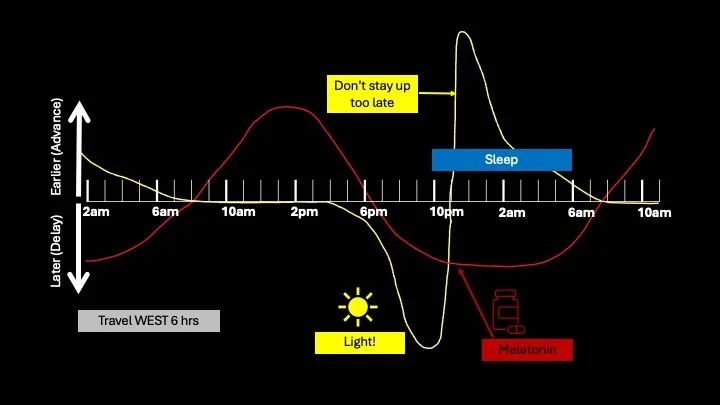
Phase response curve to light and melatonin, after westward travel 6 time zones.
Tada!! When the plane lands, the time has changed! Look at the X axis on the new PRC, which has shifted 6 hours. Since you have traveled west, you need to delay your circadian rhythm, which means doing the things below the X-axis, and avoiding things above the X-axis.
The most important jetlag cure flying west: expose yourself to bright light, preferably sunlight, in the late afternoon to evening.
As you can see on the graph, there is a yellow trough around 4-10pm, meaning that light exposure at that time will shift your circadian rhythm later. Wear sunscreen, but if you can tolerate it, take off sunglasses and let the light hit your eyes in the evening. Go for a long walk in the late afternoon, eat dinner al fresco, or use a light box in the evening. (Absolute bare minimum if you can’t bear to leave your hotel: pluck your eyebrows or some other self-care using in a lighted mirror.)
Second, avoid napping during the daytime. You want to build up your sleep drive as much as possible so that when you do go to bed, you will fall asleep into a heavy, deep sleep. If you are feeling really sluggish and absolutely must sleep, set an alarm to take a 1 hour-or-less nap, and end it before 3pm.
Third, you can boost the circadian effect by taking melatonin right at bedtime (if you’re going to bed around 10-11pm to midnight) which is right around the red valley on the graph, meaning melatonin will also delay your circadian rhythm. Amazingly, taking melatonin at bedtime works for both eastward and westward travel jetlag, for opposite reasons!
Again, please note that melatonin is considered a prescription medication in many countries, however lower doses can be sold over-the-counter in some countries. In terms of melatonin dose, a high-quality review of 10 clinical trials (link) found that 0.5 mg up to 5mg were effective, with the higher end being better for the sleep effect, and that slow-release formulations do NOT work well.
Fourth: Sleep drive puts you to sleep but your circadian rhythm keeps you asleep… this means that with westward jetlag, you’ll likely wake up earlier than you would like. To try to avoid interruptions to your sleep that will wake you up, try your best with eye mask, ear plugs, etc. Still, you may wake up early. If this happens, do NOT get bright light in the early morning! See the yellow mountain on the PRC from around midnight to 6am? That means that light at that time will advance your circadian rhythm—the opposite of what you want. If you can’t get back to sleep, get out of bed and do something quiet in dim light (reading, etc — NOT on a screen) until it’s time to actually get up for the day.
Recap: for travel westward ~6-8 time zones:
🌞 Get light in the late afternoon to evening (4pm-10pm)
🚫 Avoid napping during the daytime and on the plane trip there.
💊 Take melatonin right at bedtime.
📖 If you wake up in the early morning and can’t get back to sleep, do NOT get bright light, including from a screen. Read or do something else in dim light.
That’s it, pretty simple! If you follow the tips above for a couple days, your brain will cure itself of westward jetlag in a jiffy. Happy travels!
