
Teas for sleep
For centuries, cultures around the world have turned to herbal teas (tisanes) for their calming effects. I visited with Kateri Meyer, owner and proprietor of Traveling Tea, a local tea shop, to taste some sleepy teas and talk about the science and traditions behind teas.
Not all “sleep teas” are created equal. Some have real evidence behind them, while others rely more on herbal history. In this post and episode, we’ll explore which teas may actually help with sleep, what the science says, and how to use an evening tea ritual to support better nights.
Modern research is now beginning to explain the brain pathways that certain plants—like chamomile, valerian, passionflower, and lavender—may act through to support sleep. And while the chemicals in the teas themselves can be helpful, the ritual of slowing down with a warm drink may be just as powerful.
Listen as we discuss:
The ritual, mindfulness, relaxing routine of tea is just as important as what’s in the tea
There is usually a big placebo effect on sleep. Enjoy it!
Chamomile, valerian root, passionflower, and lavender have clinical trial data to support their use for improving sleep.
Many of the clinical trials used capsules rather than teas, and the dose you get in teas may be substantially less.
Why you should avoid chamomile if you have a ragweed allergy
Tips for brewing tasty teas
Individuals at risk for bleeding or take blood thinners should be aware that valerian root, magnolia bark, and other tisanes/herbals may increase their bleeding risk.
Bonus: best name for a Cat Cafe ever
Listen to or watch the episode, or read the transcript (at the bottom, past the picture of 4 teas). Notes with references to the studies discussed are below the audio and video players.
And of course, all the teas we tasted, and many others, are available at Traveling Tea — you can order online or shop in person.
Teas and tisanes tasted
Sleep Tight: Chamomile, Spearmint, Lemon Balm, Valerian, Lemongrass, Passion Flowers, and Rose Petals
MauHaus #6: Catnip, Spearmint, Basil, Violet, Dandelion leaf, and flower petals
Listen here
Watch here
Notes on specific teas
Chamomile (Matricaria chamomilla L.)
Apigenin is the chemical in chamomile that seems to act on sleep, through GABA-A receptors.
A meta-analysis of 10 studies with chamomile (total 772 patients) showed a reduction in Pittsburgh Sleep Quality Index (PSQI) of 1.88 points. (Kazemi 2024)
One of the included studies was in nursing home residents (mean age 70-71) without specific sleep problems, who took chamomile 200mg capsules (or placebo) twice per day for 28 days. PSQI improved more in the chamomile group. (Adib-Hajbaghery 2017)
Another included study was in 34 people (25 women) age 18-65 with primary insomnia. They took 270mg chamomile capsules (or placebo) twice per day for 28 days. There was no change in nighttime sleep, and a slight (but not statistically significant) improvement in daytime functioning. (Zick 2011)
Valerian root (Valeriana species)
Multiple mechanisms to affect sleep: GABA-A receptor activation, adenosine receptors, serotonin receptors; recently two chemicals in valerian root (Hesperidine and valerosidate) also shown to bind to orexin receptors. (Shenoy 2025) Hops which are frequently combined with valerian may bind melatonin receptors.
A randomized clinical trial of 41 people (22 women, mean age 37, all had abnormal sleep quality at baseline based on PSQI>5) who took a combination of valerian 500mg and hops 120mg (or placebo) for 21 days showed an increase in total sleep time of 7.2 minutes (6.73h post-treatment vs 6.61h pre-treatment) and 21 minute benefit over placebo.
A double-blind, randomized clinical trial of 42 people tested a single dose of liquid valerian and hops extract plus honey in water (ie it was drunk as a tea or tisane) or placebo, and had sleep measured with a semi-automated scoring system. This showed an overall increase in total sleep time and time in deeper sleep with valerian & hops. (Dimpfel 2008)
A randomized clinical trial in 16 women with insomnia (mean age 69) of just valerian (300mg) or placebo, taken 30 minutes before bedtime for 2 weeks, and using self-report, actigraphy, and polysomnography outcomes, showed no difference between groups. (Taibi 2009)
A study in 64 people testing a combination of L-theanine, lemon balm, valerian, and saffron did not show benefit compared to placebo. (Gudierrez-Romero 2024).
See study on triple combo of valerian, hops, and passionflower in “Passionflower” section below.
Lavender (Lavandula)
Almost all of the 46 randomized controlled trials in pubmed are for aromatherapy
A randomized controlled trial in 221 people with anxiety tested lavender oil (80mg per day for 10 weeks) vs placebo and showed that PSQI decreased (improved) by 5.5 points, versus 3.8 with placebo. (Kasper 2010)
A randomized controlled trial of lavender flower powder (500mg), bitter orange powder, and placebo in 156 postmenopausal women showed that there was an improvement in the PSQI in the lavender and bitter orange groups. (Kamalifard 2017)
Passionflower (Passiflora incarnata Linnaeus)
Randomized, double-blind placebo-controlled study of 110 people with insomnia (mean age 40, 54% female) tested passionflower versus placebo for 2 weeks. This study found there was 23 minutes increase in total sleep time with passionflower using polysomnography (vs -0.1 minute for placebo). (Lee 2020).
Combination of valerian 300mg, hops 30mg, and passionflower 80mg was tested against zolpidem (Ambien) in 91 (63 male) people with insomnia. The two groups showed similar effect, with total sleep time increasing from 206 to 252 minutes for the herbal combination group, and 212 to 324 minutes in the zolpidem group. (Maroo 2013) *Note that the triple combo is sold as Kyatta-Sedativum® in German.
No randomized clinical trials for sleep found in Pubmed for
Catnip – Nepeta cateria
Linden flower – Tilia
GABA Oolong
References
Adib-Hajbaghery M, Mousavi SN. The effects of chamomile extract on sleep quality among elderly people: A clinical trial. Complement Ther Med. 2017 Dec;35:109-114. doi: 10.1016/j.ctim.2017.09.010. Epub 2017 Oct 13. PMID: 29154054. Pubmed
Dimpfel W, Suter A. Sleep improving effects of a single dose administration of a valerian/hops fluid extract - a double blind, randomized, placebo-controlled sleep-EEG study in a parallel design using electrohypnograms. Eur J Med Res. 2008 May 26;13(5):200-4. PMID: 18559301. Pubmed
Gutiérrez-Romero SA, Torres-Narváez ES, Zamora-Gómez AC, Castillo-Castillo S, Latorre-Velásquez AL, Betancourt-Villamizar C, Mendivil CO. Effect of a nutraceutical combination on sleep quality among people with impaired sleep: a randomised, placebo-controlled trial. Sci Rep. 2024 Apr 5;14(1):8062. doi: 10.1038/s41598-024-58661-z. PMID: 38580720; PMCID: PMC10997602. Fulltext.
Kamalifard M, Farshbaf-Khalili A, Namadian M, Ranjbar Y, Herizchi S. Comparison of the effect of lavender and bitter orange on sleep quality in postmenopausal women: A triple-blind, randomized, controlled clinical trial. Women Health. 2018 Sep;58(8):851-865. doi: 10.1080/03630242.2017.1353575. Epub 2017 Aug 25. PMID: 28749734. Pubmed
Kasper S, Gastpar M, Müller WE, Volz HP, Möller HJ, Dienel A, Schläfke S. Silexan, an orally administered Lavandula oil preparation, is effective in the treatment of 'subsyndromal' anxiety disorder: a randomized, double-blind, placebo controlled trial. Int Clin Psychopharmacol. 2010 Sep;25(5):277-87. doi: 10.1097/YIC.0b013e32833b3242. PMID: 20512042. Pubmed
Kazemi A, Shojaei-Zarghani S, Eskandarzadeh P, Hashempur MH. Effects of chamomile (Matricaria chamomilla L.) on sleep: A systematic review and meta-analysis of clinical trials. Complement Ther Med. 2024 Sep;84:103071. doi: 10.1016/j.ctim.2024.103071. Epub 2024 Aug 4. PMID: 39106912. Pubmed. Fulltext.
Lee J, Jung HY, Lee SI, Choi JH, Kim SG. Effects of Passiflora incarnata Linnaeus on polysomnographic sleep parameters in subjects with insomnia disorder: a double-blind randomized placebo-controlled study. Int Clin Psychopharmacol. 2020 Jan;35(1):29-35. doi: 10.1097/YIC.0000000000000291. PMID: 31714321. Pubmed.
Maroo N, Hazra A, Das T. Efficacy and safety of a polyherbal sedative-hypnotic formulation NSF-3 in primary insomnia in comparison to zolpidem: a randomized controlled trial. Indian J Pharmacol. 2013 Jan-Feb;45(1):34-9. doi: 10.4103/0253-7613.106432. PMID: 23543804; PMCID: PMC3608291. Fulltext
Schicktanz N, Gerhards C, Schlitt T, Aerni A, Müggler E, de Quervain D, Papassotiropoulos A, Boonen G, Drewe J, Butterweck V. Effects of a Valerian-Hops Extract Combination (Ze 91019) on Sleep Duration and Daytime Cognitive and Psychological Parameters in Occasional Insomnia: A Randomized Controlled Feasibility Trial. Brain Behav. 2025 Jun;15(6):e70600. doi: 10.1002/brb3.70600. PMID: 40462685; PMCID: PMC12134488. Fulltext
Shenoy AG, Ravi V, Subair S, Varman DR, Raju R, Rehman N. Discovery of natural orexin 2 receptor antagonists from Valeriana species: A potential approach for insomnia treatment. Chronobiol Int. 2025 Aug;42(8):1107-1120. doi: 10.1080/07420528.2025.2529398. Epub 2025 Jul 16. PMID: 40667860. Pubmed.
Taibi DM, Vitiello MV, Barsness S, Elmer GW, Anderson GD, Landis CA. A randomized clinical trial of valerian fails to improve self-reported, polysomnographic, and actigraphic sleep in older women with insomnia. Sleep Med. 2009 Mar;10(3):319-28. doi: 10.1016/j.sleep.2008.02.001. Epub 2008 May 14. PMID: 18482867; PMCID: PMC2709274. Fulltext
Zick SM, Wright BD, Sen A, Arnedt JT. Preliminary examination of the efficacy and safety of a standardized chamomile extract for chronic primary insomnia: a randomized placebo-controlled pilot study. BMC Complement Altern Med. 2011 Sep 22;11:78. doi: 10.1186/1472-6882-11-78. PMID: 21939549; PMCID: PMC3198755. Fulltext
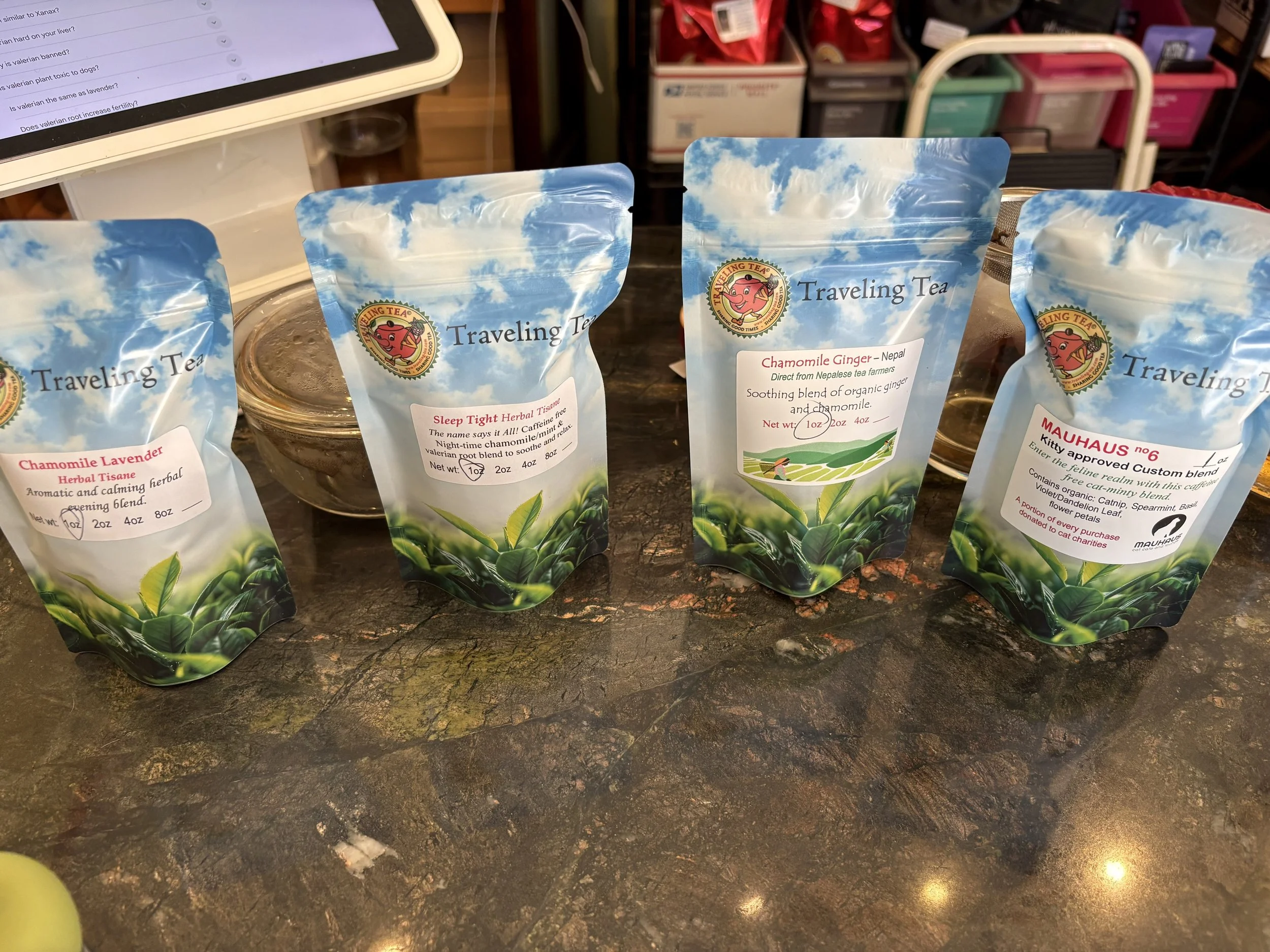
Sleep-friendly teas and tisanes tasting
Transcript
Yo-El Ju: Hi Kateri.
Kateri Meyer: Hi Yo-El.
YJ: So this is our sleep or sleepy tea interview. I'm super excited. Do you want to introduce yourself?
KM: Kateri Meyer - Traveling Tea - been in business since 2009 and I've had this shop since 2013. As I mentioned a few minutes ago, with everything that's going on in the world my number of people coming in the door asking for sleep teas to help them sleep has doubled.
YJ: Yeah. After everything in the news, after every event, I get lots of messages or calls from friends or patients or whatever asking what can I do to sleep better? So I love tea and I figured this would be a fun thing to do.
So you can be the tea expert and then I looked up stuff about any clinical trials about different tea ingredients so we can go over the, well there's a limited amount of information -- we could go over the science..
KM: Right, a lot of it, it’s apocryphal or a historic herbalism thing. And that's the thing. I don't sell myself as an herbal shop. I have people coming in here asking. I’ve got a few tea leaves that I know the herbs have a history of helping with various things. If it’s people coming with major digestion stuff or whatever there's two good herbal shops less than a mile away… go there. They're trained in that stuff.
These teas historically, Chamomile, everybody knows about Chamomile and Valerian root. Those are the two big ones that everybody knows about.
Some people can't do chamomile, and this is something not everybody realizes, that if you have a ragweed allergy you shouldn't drink chamomile especially when ragweed's in bloom, because it's in the same plant family.
YJ: Yeah, so a lot of people have ragweed allergies, especially in the Midwest. I did not realize that there was a cross reactivity with chamomile so I looked it up. If you're allergic to Astericea, which is like sunflowers or ragweed.
KM: Sunflowers too? didn't realize that.
YJ: If you're allergic to ragweed, then instead of chamomile, what can you have?
KM: You can do linden flower. I used to have a linden flower blend and I don't know whether it was the flavor I just needed to tweak, but it wasn't very popular and so I discontinued it as of the end of last year, because I had to bring in all the ingredients just to make it and it just wasn't cost effective. You can get linden flower at herbal shops, and as I said they're less than a mile away.
I do have a blend I made for the Cat Cafe. It has catnip in it. And catnip is calming to the human nervous system as I understand it.
YJ: Is this for cats or humans?
KM: It's for humans! [Laughter] If humans have cats sometimes they have to fight their cats for their tea. They told me I can't do that one because my cat always gets into the tea bag or whatever you know. I have had people who repeat buy it and say that it's more calming for them than valerian root. You know that's just whether it's psychosomatic or what, you know, doesn't matter if it works, right?
YJ: Right. I guess the main thing is for teas for sleep you want not real tea which has caffeine in it. You want tisanes I guess. So other herbs or flowers or fruits that taste good and hopefully also help promote relaxation.
KM: Yes. I think if it doesn't have caffeine and if you enjoy it, it's relaxing to drink a nice hot cup of tea before you go to bed. It's gonna help.
YJ: Yeah, so I think like the main thing actually is not the tea. Like I'm gonna have some now and I don't expect I'll fall asleep driving home after this. Having tea as part of a nighttime routine where you kind of like catch the wave of drowsiness and have it as part of your usual wind down. That's how it really helps you, like it's not gonna knock you out.
KM: Although I understand Valerian root can be somewhat drowsy making, I don't really know.
YJ: I looked up the different mechanisms. I guess starting with chamomile... all of these plants have many, many different chemicals in them. And they've tried to identify which of those might be the ones that are active. So in chamomile, there is apigenin and that binds GABA receptors. So they think that is the main sleep promoting effect of chamomile, but then chamomile has a lot of other potential effects like, you know, anti-inflammatory effects, it has effects on kind of calming your GI tract and so on. But in terms of sleep, seems to be on the GABA receptors. GABA is the main inhibitory transmitter in the brain as opposed to excitatory like acetylcholine. Increasing GABA activity is sedating. Drugs that act on GABA are things like benzodiazepines, like Valium, or alcohol increases GABA activity, and so on. So it is expected that if you increase GABA activity, or receptor agonism, then it should make people more sedated.
KM: So that explains the tea, various teas, first one I was introduced to was GABA Oolong. There's also a GABA green from somewhere. I learned from one of my friends… I believe it was the Japanese discovered that if they infuse the room with nitrogen while the tea leaves oxidizing is naturally occurring GABA properties within tea, multiple times.
YJ: Cool. But oolong has caffeine in it.
KM: The caffeine in tea is different because it goes to your brain rather than your heart. And it has L-theanine in it, that's calming.
It became so popular because it was spread through buddhism. Because the monks used it so they could stay alert for long hours of meditation and still not have it interfere with their with their meditation.
YJ: Not get all hopped up.
KM: Exactly.
YJ: All right, well, are we going to try one or more of these? Yeah. So let's see. This one is chamomile lavender. And ... and this is Sleep Tight, which is
KM the Valerian root.
YJ: It’s just Valerian?
KM: It’s Chamomile, spearmint, lemon balm, Valerian lemongrass, passion flower. It's got rose petals in it.
YJ: And this one's chamomile ginger; and then this is the catnip with mint, basil. And then this is the...
KM; The GABA oolong.
YJ: All right. What would you recommend? You're the expert.
KM: Well, let's go with flavors. I want you to try one of the Chamomiles and the Sleep Tight so you can Taste the difference because, that's the thing with a lot of medicinal tea, the herbs that actually do the work can tend to be little bitter. And so that's where they mix all that other stuff with it, the mint and everything else.
YJ: Chamomile tastes good though, you know, it’s very mild.
KM: Mm-hmm. A lot of people like chamomile.
YJ: I feel like my nose is not up to its usual functioning because I'm getting over a cold.
KM: I think ginger would be better rather than the Chamomile Lavender because then you got the ginger to help clear your stuff. Okay this is the chamomile ginger.
YJ: All right. Do you already have water?
KM: I have water ready, but I just got…
YJ: Okay. All right here. I'll go over the clinical trials for chamomile while you brew. So in terms of studies that I looked up, I wanted to find studies that were published in peer reviewed journals in PubMed, where it was randomized and controlled meaning they used a placebo to compare.
For chamomile there's a decent number of studies and they did a meta-analysis meaning they pooled data from several of these clinical trials. So there was a meta-analysis done in 2024 that combined 10 studies that had a total of 772 patients. So it's actually a pretty large meta-analysis and they found that there was an improvement or a reduction in a score called the PSQI which is the Pittsburgh Sleep Quality Index. That's probably the most commonly used scale of sleep quality. So that decreased close to two points across all these different studies. And then in four of the studies that looked at how fast people fell asleep, that improved in three out of the four studies.
And then there were no significant adverse or side effects. But they only use passive reporting, meaning they didn't specifically query for all the different things like you would in say like a drug trial in terms of side effects. Overall, there's pretty good data that there's an improvement in subjective sleep quality. I don't think any of these measured sleep objectively like with an actigraph, which is a motion sensor or with a sleep study. But still overall, I would say, you know, two point improvement in the PSQI is pretty good.
KM: What's the range?
YJ: So two points, I would say two is a small effect. And then in terms of the actual studies that were included, there were a couple. So some of the studies that they included were specific patient populations like people who had chronic kidney disease or you know this or that So I tried to pull out the ones that were maybe more relevant to a general audience
There was one that they included that had 60 people who were older and they lived in kind of like an old folks home in Iran And they did 200 milligrams of chamomile extract in a capsule not a tea - so none of these studies used teas.
KM: None the studies used actual teas.
YJ: Yeah, or very few do. A lot use capsules or oils, which yeah, so it's, it's not exactly comparing apples to apples, I guess. And, and they took it twice a day, which I thought was interesting. But they found that the group that got the chamomile capsules versus the placebo capsules did have an improvement in their sleep quality. But these were just regular people. They didn't necessarily have sleep problems to start with. So that was one study.
And then another study that they included was adults, so 18 to 65 years old. This was a small study, 34 people and about two thirds of them were women. And these are people who had insomnia, meaning they had problems sleeping. And they got 270 milligrams of chamomile, again, twice daily for a month. And they followed, or the people kept track of their sleep with a sleep diary. And then they also measured daytime symptoms.
And in this study, when they took people who had insomnia, there was no difference in terms of their sleep and their sleep diary. But there was a slight improvement in their daytime functioning. So I think the data are a little bit mixed -- when they pool all the studies together, there is a small benefit on sleep. But I think when if you take people just who have true insomnia, where they would see a doctor for it, the effect probably is not strong enough to see.
KM: I wonder if instead of taking capsules, if they were actually having a tea and sitting down and having that intentional time. I think that would be much more productive.
YJ: I think so too. So I think that a lot of it is the actual ritual and the bedtime routine and the warm mug and all that stuff. That's like almost all the effect.
KM: Yeah you have to pull your attention away from your day and you have to focus on making this cup of tea.
YJ: And enjoying it, you know, just being mindful and enjoying the smell and the feeling and the taste and everything.
I will also say that even in clinical trials of sleep drugs, Ambien, Lunesta all of these. There is a significant placebo effect, which is really prominent for insomnia. So about two thirds of the effect is placebo.
KM: With real drugs?
YJ: With real drugs! This is because there is so much of our expectation and anxiety and worry and you know our ability to kind of shut off our thinking that affects our sleep. It’s not uncommon to see 30 or 40 minutes of objectively measured sleep, like during a sleep study, and that benefit can be sustained over weeks during clinical trials with placebo. So our brains are actually very powerful and are able to improve our own sleep. Placebo is very strong, especially for sleep.
Alright, so ready?
KM: Probably a lot of what prevents sleep is a lot of mental.
YJ: Yeah.
KM: After you've ruled out physical things, physical aches and pains.
YJ: This is chamomile ginger.
I love that, the ginger is nice.
KM: This particular tea is from Nepal. It's all grown there and I buy it farm direct from Nepalese tea farmers.
YJ:So how do you source all of your teas? Like how do you know people in Nepal?
KM: Well, interestingly, Nepal, centuries ago, Nepalese workers, went to Darjeeling, which is the very northern part of India. These workers would travel to Darjeeling for work picking tea, and making tea. So they had the skills for it, but they weren't growing it. Well, the gentlemen who have formed this tea collective, they were the grandsons of a farmer who said, we should grow tea here. This is silly! We have the, we have the land, we have the same terroir, we can do this. He had a hard time convincing them, but over time he did.
He sent his grandsons off to the west to go to business school. And they came back to Nepal and said, okay we're doing this. And I can't remember how many years it's been now more than 10, I think. But they've gradually been building and building and so the farmers are making a much better living. So they travel and they go to the tea expos and things like that and that's how I met them.
Other teas, like the fruit tea, valerian, chamomile lavender.. those I have vendors who have been in the business longer than me. They source this stuff and make the blends, and I just buy them from them and repackage them.
YJ: And most of your stuff is organic because I know like you will actually note if it's not organic, right? So by default all your stuff is organic.
KM: Unless it says otherwise, right? Well, GABA (Oolong) might not be. I can't remember. It doesn't say, so it probably is.
But a lot of them, especially the Chinese teas and stuff that, I try to source from areas that are away from civilization and a little bit more wild.
YJ: Alright. Okay. So, let me go through my notes here. So, there are a couple other. So, besides chamomile, I think the next one that you mentioned was Valerian root or Valeriana species. So, this one actually the science was very cool because there's a lot.
In terms of the mechanism, it also acts on GABA receptors, but there's other compounds in valerian root that acts on adenosine receptors. That's what caffeine works on, but it acts on adenosine receptors the opposite way. Also serotonin receptors.
And then really recently, last year, they found that two of the compounds in valerian root, called Hesperidine and Valerosidate, they actually bind to orexin receptors. So there is this new, newer family of drugs called orexin antagonists. So orexin is a chemical that increases alertness in the brain. And more recently, they have developed a new class of sleep drugs that block those receptors to kind of shut down the waking pathways to help people sleep. And this is an interesting class of receptors because a lot of the research being done on the interaction of Alzheimer's proteins and sleep targets this receptor. Anyway, it's very interesting in that two of the compounds from valerian root seem to bind to this receptor very strongly, in a similar mechanism as this new class of sleep drugs.
KM: Cool.
YJ: So valerian root seems to have multiple mechanisms by which it may enhance sleep. There's pretty decent data. So it seems like at least in the clinical trials, a lot of times valerian root is mixed with hops. Did you know this? Hops like we would use in beer. Yeah, so there was one where they did a combination of valerian roots extract with hops.
KM: I'm sure it (extract) makes it easier for them to control the studies.
YJ: Yeah. And they took it, they had 41 people, half of them were women, and it was mean age of 37. So just like regular people, but they had to have a little bit of sleep problems to start with. And they took it an hour they took the extract an hour before bed. And the treatment group compared to the placebo group got 21 or 22 minutes more of sleep. And they actually used Fitbit tracker to measure this. So that's actually pretty good. So 21 minutes is pretty good.
KM: Do we know whether the hops had any effect?
YJ: We don't know. But it is interesting to me that the two have actually been tested a lot together.
And then there was another one where it was a combination of valerian roots and hops and this one they use sort of like a sleep study but it was like a semi automated computer thing. And again, they seemed to find an improvement in total sleep time and deeper sleep. And this one was interesting because this was liquid with honey, so it was as a tea.
And then there was a trial of just valerian extract versus placebo. This was just women who were older, like post-menopausal women who had insomnia, and this did not help them. So, yeah, so I think that in general, these clinical trials, tend to do better if the people don't have bad insomnia to start with.
KM: Right, yeah. So it's not going to cure your insomnia. It's not going to hurt it.
YJ: Yeah, it's not going to hurt it. It doesn't cure insomnia. I think that if people have significant clinical insomnia, there's a bunch of other things that need to be done in terms of addressing.
KM: And again, I'm going to go back to this, these studies are just doing single herbs and single this and single that. I did study with a shaman for a few years and he wrote a book and the book he talked about western medicine, some guy studying chemicals and stuff in South America or wherever with the shaman and the shaman was going through the jungle pointing out different plants and saying we use this for that and we use this for that and the guy's trying to write this down and get all this information and the shaman just laughed at him because it's not the single chemicals. It's the whole interaction of plant. So the studies they find active chemicals but the chemicals aren't actually just working by themselves, you know? So how valid is the study that's isolating one chemical?
YJ: Right. Alright, so this one (tea) is
KM: This is the Sleep Tight. This is one with valerian root and the chamomile and all the other stuff to make it taste good.
YJ: And this one has the passionflower too. So I actually looked up passionflower. Yes, so passionflower, I was very surprised to find out there is a lot of data on, not a lot, but I mean more than I expected. So passionflower is the flower that's on vines for passionfruit. I was also interested to find out that it doesn't increase passion. It's named passionflower because it has to do with like the number of petals or something represents different things in the Passion of the Christ according to missionaries who went to Brazil. So it's so not the kind of passion you thought it would be.
There was a double blind randomized placebo controlled trial where they used sleep studies, polysomnography, in 110 adults. This was published in 2020. It increases sleep time on sleep studies by 23 minutes. So passionflower actually has very high standard data to support its use.
Also, there was another study that used a combination of valerian, hops and passionflower. So this is also a very common combo, these three. And the study of the the triple combo they went they went all out and they compared it against zolpidem, which is Ambien. So it was not placebo controlled, they tested it against zolpidem. And it actually did just as well as zolpidem. This was 91 people in the study with insomnia and total sleep time increased from 206 minutes to 352. So that's a huge difference. So these people were really insomniac at baseline. And then for zolpidem, they went from 212 to 324 minutes. So it was a similar increase in this study.
And what I thought was notable is that they mentioned that in Germany, combination of Valerian, hops and passionflower is actually approved and sold under this name Kyatta-Sedativum(R)
So you know in Europe they have much better and tighter regulation of herbal supplements and nutritional supplements. So I thought it was interesting that they actually sell this combo of the valerian root, passionflower, and hops.
KM: Interesting. Yeah. Maybe I need to try to find some of that.
YJ: Yeah, or get some hops.
KM: Yeah, get some hops. I'm gonna ask them at the herbal shop and see if they use hops in it.
YJ: I was very surprised. I did not realize there was that much data for passionflower, but that one actually seems very, very strong scientific evidence, I would say, compared to the other, to the other teas. Alright, so this one also has the chamomile we talked about, it has the passionflower, and then the valerian. Okay.
KM: Right. It has mints in it for flavor. Although that’s a really good job because these ingredients are on here in order of volume you know so the chamomile is the primary ingredient and it tastes good.
YJ: I do like anything with lemongrass, it's so fresh.
KM: It's lemon balm.
YJ It’s is lemon balm? Oh and there’s lemon grass.
KM: is there lemon grass too? I missed that.
YJ: Okay. This one's good.
Alright, and then there were a couple others (teas) that I looked up. So lavender, obviously. So we have the chamomile lavender. I found 46 randomized clinical trials in PubMed, but almost all of them were for aromatherapy. So there were a lot that used just the smell, or some actually used it in terms of like as a massage oil.
For actually eating it or drinking it, I found two studies. One of them was a trial in women. They did a trial of 52 post-menopausal women and they did a lavender flower powder or a bitter orange powder or a placebo. Sorry actually it was 52 people per group. So was a pretty large study. And they found that there was a decrease in the PSQI, the Pittsburgh Sleep Quality Index, they found there was a decrease in both the bitter orange and the lavender. Only the abstract is available. I couldn't read the full study, but I thought that was interesting that orally it seemed to work as well. So bitter orange is the other one.
KM: Interesting.
YJ: And then there was another study that it was by mouth. It was a lavender oil by mouth. So I don't think it was an oil. I think it was encapsulated.
KM: Yeah, I would think you would have to.
YJ: Yeah, and that one, this second study was in the International Clinical Psychopharmacology Journal. This was a large study. It was 221 adults with anxiety. They found that taking the lavender oil by mouth for 10 weeks decreased that PSQI score by five and a half points on average.
KM: I know there have been aromatherapy studies with lavender on kids with hyperactivity too.
YJ: Yeah. There aren't that much data for lavender by mouth. The vast majority are using the smell. But, you know, the studies that are there seem reasonable and if no bad side effects.
KM: Well there’s a little bit of an aroma, if you can smell it. Alright, where do you wanna go next?
YJ: Well should we do the Chamomile lavender? So do you have a kettle that just keeps it at the correct temperature?
KM: Yeah.
YJ: So what temperature do all these go? These aren't boiling.
KM: Well, they say nearly boiling. Nearly boiling. I'm doing them at 195.
YJ: As opposed to 212. Okay.
KM: This one says boiling. It could be near boiling. The thing with herbs is teas you want to, especially green teas, my gosh. The biggest thing that got me into the tea business was all the packages you buy in the grocery store for green tea say use boiling water. Don't use boiling water. You'll make a very bitter cup of tea. You want to use much less than boiling water, maybe more around 185 depending on the tea. There's lots of different green teas and they all do different things. And you're going do it for very short time, just a couple minutes, not three to five minutes, which is most black teas, you're going to do three to five minutes. You can't brew a green tea like you do a black tea. It makes it bitter.
It pulls out all those, I can't remember what the chemical word is, polyphenols maybe, and just makes a bitter cup of tea. Now herbal teas, they can handle the hot water. You can't oversteep them. You could leave them sit for, and actually I think therapeutically, if you really want therapeutic doses of herbs, you're gonna put it in the water and you're gonna simmer it on the stove for 20 minutes or something. I don't know how good that's gonna taste but you're gonna get all the chemicals out of those herbs.
YJ: Sludge.
KM: I know there's Chinese medicines that that's how you're supposed to take them. So, you know, that was the thing I wanted to ask you about. Did you find anything on any contraindications for any of these? Did you look up anything about contraindications?
YJ: Yeah, so the major one is for anyone on blood thinners or anyone who has hemophilia or some other bleeding disorder. Valerian root can interact and make it more likely that someone will bleed. And that seemed to be like the main one with a lot of these is the potential for bleeding.
And then what was the other one? Oh, and then we haven't talked about magnolia bark yet, but that one and Valerian root were the main ones that thin your blood out.
And then of course the other ones can cause, know, drowsiness, dizziness, stomach upset, the cross reaction with people with ragweed allergy, like we mentioned. But I mean, I guess in general, the, you know, the teas we're talking about are all considered, they're kind of considered generally safe by the FDA.
KM: Yes.
YJ: They're like foods. They're regulated like carrots.
KM: That speaks to what I talked about with therapeutic doses. You're not really doing a huge therapeutic dose. That's also probably why they use extract to get therapeutic doses. All things in moderation. You do one cup of tea a day. The amount of actual chemicals that are going to interact with your medications are very small.
YJ: Yeah. And then for the oil especially, like with lavender oil, it can cause skin irritation.
KM: You’re not supposed to put them directly on the skin they're supposed to be in a carrier oil or something to thin it out.
YJ: But I mean overall it seems like these are pretty well tolerated and you know if if you're drinking tea to help yourself fall asleep then hopefully getting drowsy is not a bad thing.
KM: That is the goal.
YJ: So there was one other tea. That was the Magnolia Bark.
KM: Yeah, that's not something I'm familiar with.
YJ: I guess it's called Houpo in traditional Chinese medicine. The bark has a lot of different compounds with numerous different mechanisms, but the clear mechanism of action on sleep is not yet known. That's the other one.
Otherwise, I did look up GABA Oolong. There were no trials in adults. It looks like there has been one in children with autism spectrum.
And then there were no clinical trials for catnip or linden flower.
KM: Okay.
YJ: Do you like like all the little cups and things? ‚
KM: I have to have quite a variety of things.
YJ: Oh this one smells really good. Oh that's good.
Yeah, I've had this one a bunch before so I feel like this one is like the Pavlovian one that makes me feel relaxed.
KM: That been around since the beginning it's like the second vendor I ever took on. It's their blend.
YJ: So you've been open since 2009? My goodness.
This is yummy.
KM: I started with two vendors in 2009. And then now I'm up to like, I don't know, tried to count -- 10 or 12 vendors, including FarmDirect, because I have two or three sources for FarmDirect to them.
YJ: Do most people buy in person or is it online?
KM: Most people buy in person. I do have a decent online business. I ship out probably 10 packages a week. lot more during the holidays. But I'm still not... I see pictures from some other small businesses and they've got these big walls of boxes of stuff to go out the door and I'm like, that's not me. You get personal attention here because it's so small.
YJ: Yeah.
KM: So we also do single serving.
YJ: Cool. Happy throat lemon, I need that.
KM: That's a brand new one that's my own blend. I created that last year. For somebody who wanted -- I have a mint version that we've had for years and years and I have a number of singers who like that one a lot. Okay. And then I had well, a friend who doesn't like peppermint, doesn't like ginger, and doesn't want those things. And so I created the Happy Throat Lemon.
YJ: What's in the happy throat lemon?
KM: Marshmallow root, licorice root, lemon myrtle, echinacea, dandelion leaf, anise, hyssop, and sage. It works pretty well.
YJ: And how many ounces is this?
KM: That will make one 16-oz cup of tea.
YJ: One cup of tea. Okay.
KM: That's we offer those when somebody comes in and is brand new to tea and I suggest this is what you do: Just go through and pick some flavors or you want me to pick you some out I'll pick out some bestsellers and then you just start you drink them and you see if you like them and then and that seems to work really well for people
YJ: Yeah, because when you get the whole ounce, it’s a lot, 24 cups.
KM: Right. [Laughter]
Alrighty, so we've done everything except the GABA oolong. Oolongs are very interesting because most of them are tightly rolled.
YJ: Do they roll up on their own or?
KM: No, that's humans do that or machines. They have machines that do it too with humans overseeing it. It's not robotics yet. And you'll see as I brew this, this is going to open up and be a whole leaf.
YJ: Oh cool!
KM: So they're kind of fun and you get lots of steeps out of it. Let's see now. I'm refreshing my memory on how many minutes for the first infusion. So there's two different ways you can do this too on this package. This is from a company out of England called My Leaf Tea and they give you both the Chinese way of doing it, called Gong Fu where you would use like five times that much leaf for the same amount of water and you just do a lot of short steeps. And so you get more steeps out of it. And the whole Gong Fu process is just relaxing too. Even though it's tea and it's got caffeine, it's just a relaxing process.
YJ: So do you use the metal infusers usually or?
KM: What I did with most of these is I have a side port, it's got a strainer on the inside. Personally at home I use a strainer like this. And this just fits in your cup, you know, and you just take it out and put it on the saucer.
YJ: I like these because then you don't have to throw out a bag every time. And I've recently become like terrified of microplastics.
KM: Right. plastic ones. Yeah. I have bags here that, they tell me they're certified, don't have any plastic in them. It's got a little bit of some kind of a plant-based glue that holds them together. But yeah, we've got a whole assortment of strainers and things we just started carrying last year.
YJ: Oh, these are so cute.
KM: They float.
YJ: Oh, I get it, they float.
KM: This is food grade silicone.
YJ: That is too cute. Aww.
KM: And so they work great in travel mugs because they float and the seal and everything, you know. Yeah. There's a cat.
YJ: What is this? Oh, another cat. Aww there's an otter!
KM: I think the otters are my best seller.
YJ: So when you started Traveling Tea, did you think that it would last for this long?
KM: I hoped it would. I actually had hoped that I would be able to quit my day job sooner than I did.
Yeah. See, so that was just one steep, that's how they opened up. I should have given it a rinse first. That would have helped it open up more. But I'll do another steep Let's see.
YJ: That's really good. It kind of tastes a little bit like, like seaweed. Kind of has that seaweed-y, nori-like flavor.
This is really good.
Do think you'll expand somewhere where people can sit down and have tea?
KM: I don't know yet. The only way I might do that is if the donut shop next door would go out of business. Because then I could do knock a hole through, knock a door through.
So, I don't know. I purposely take small because it's manageable this way. I had if I had twice the space, I'd have to have twice the employees and
YJ: You’d have to wash all the cups and everything.
KM: Exactly. It's a lot of washing up. It is.
But we do [events] -- I did a tea tasting yesterday for a lady. She gathered some friends at her condo and took some teas and talked about tea and tried different things. And we do, like I've done, date nights where they ahare a bunch of teas. I've done one for a birthday: two friends, one friend gifted to the other to create her own tea. I got some some guidelines and I had all of the ingredients and we played around. She made her own blend and then she got four ounces of that blend. As long as I have the ingredients I could remake the blend for her any time. Yeah, it was fun. They just paid a set fee and then they got the free tea to go with it.
This is round two. To taste the difference or see if you taste the difference.
YJ: Second round of the GABA Oolong
KM: Yes, now see how much that leaf has opened up. that's so cool.
YJ: Yeah, they unfurl That's cool.
KM: Yeah and so you can just keep steeping and steeping and steeping until it's basically not water.
YJ: This (second steep) tastes like more like tea, like I mean like "tea" tea you know.
KM: And lots of times you'll get your best flavor on like your third steep.
YJ: That's really good.
KM: Yeah, so let's see then. I guess you'll find out if it relaxes you.
I want to ask you, your whole focus since you started in medical school has been the sleep, hasn't it?
YJ: Yeah, well, I did neurology first and then sleep. You can do sleep from a variety of different specialties, different medical specialties, including neurology. So I still do neurology when I'm on service in the hospital, but otherwise all my outpatient practice is sleep.
KM: And why did you choose sleep?
YJ: Because it's the most interesting. I mean, it's a relatively young field in medical research. And so I felt like there was a potential for being able to make a contribution, scientific contribution, within my lifetime, as opposed to some of these fields where there's lots of big famous people working in them, for years…
KM: For a tiny breakthrough.
YJ: Yeah, or sometimes big. I just thought it would be fun to do something that where I could discover new things and you know, there was like a good chance that I could. And also, it's a good clinical practice. You know, the actual sleep medical practice is, pretty pleasant. It's easy to balance with research. So I thought it would be a good way to stay in academic medicine and be able to do research and still have a clinical practice and be able to balance that well.
KM: Hmm. And is there something really interesting that you've learned so far? Or what's the most interesting thing you've learned?
YJ: What's the most interesting thing? Well, I guess I'm super biased by my own research. So I think it's interesting that sleep or sleep disturbances seem to predict or may be a risk factor for developing neurodegenerative diseases down the line. And perhaps our behaviors during midlife actually physically affect the mechanisms by which people may develop neurodegenerative diseases.
So to me that's interesting because it's actionable. There's so many things that... There's so many things to be afraid of, right? And we don't want bad things to happen to us. But there aren't that many things that we can do today to reduce those risks, but sleep is one of those things. So I think it's interesting that it's something we do every day that we can do something about.
KM: We didn't do the catnip one. You can taste the catnip one, you can turn the back around and look at the ingredients. It's a little bit savory compared to most of my teas
YJ: We could do the catnip. Why is it savory? … It has catnip, spearmint, basil, violet, and dandelion leaf, and flower petals. And a portion of every purchase is donated to cat charities.
KM: Actually doesn't have violet, I need to update that. Yeah, when I very first created it, I had access to violet leaf and I put violet leaf in, but I haven't had access to violet leaf since like just before COVID. I don't know why...
YJ: Maybe COVID killed them (violets) all off. [Laughter]
KM: I don't know. Whoever was in commercial production for Violet Leaf probably went out of business.
YJ: Oh this has dandelion leaves.
KM: Yeah, so my thinking was this has all plants that if a cat were outside it could conceivably come in contact with.
YJ: Aah, okay.
KM: It's called MauHaus number six because when the cat cafe Mau Haus opened, the owners came in and we had all these different ingredients and we created this blend and this was the sixth try. Of the things that we tried. So they decided that's what they wanted to name it was MauHaus number six.
YJ: I went to the cat cafe for the first time with my kids fairly recently. They loved it. It was so fun. They came up with a good name for a cat cafe, which is Gato and Gateau. Like Gato means cat in Spanish and Gateau means cake in French. So that's their idea for a cat café: Gato & Gateau.
KM: You’d better trademark that.
YJ: That's my get rich quick scheme, is to run a cat cafe.
KM: Oh you'll get rich real quick for sure.
I was told by the owners that said that by having a cat cafe‚ she can't be called crazy cat lady for having multiple multiple cats
YJ: Yeah. [Laughter]
How long do these (teas)last?
KM: Okay, herbal teas you want to buy with something that you're going to use up within six to nine months. It's just like spices, you know that same kind of guideline. Keep them in a sealed container away from heat and light. They'll stay fresh.
YJ: I forgot to bring tins! I knew I forgot something! Alright, okay, I feel so bad.
KM: I can put it in paper bags for you and you take it. We do that all the time.
YJ: All right, so this is the MauHaus #6. So this is the catnip with mint, basil, dandelion, and flower petals.
Well this one's nice and minty.
KM: Mm-hmm.
YJ: Do you have tea every day?
KM: I have some kind of tea every day. I would not be my best customer, truthfully. Yeah. I don't drink like four cups of tea a day like some of my customers do. I like having the variety though, which was my big thing.
YJ: Yeah.
KM: I don't like to drink the same tea every day. People that drink the same tea every day. I'm like, how can you do that? That just seems so boring. Of course, that's different than coffee, right? You drink same coffee every day. Yeah, I guess. Drinking the same coffee for 40 years, you know?
YJ: This is nice. I do like the minty kinds. Alright, well I need to stock up on some teas.
KM: Okay, we can do that.
YJ: All right, well thank you Kateri.
KM: Thank you for inviting me to a part of this.
YJ: Traveling tea. So the website is travtea.com, T-R-A-V-T-E-A.
It's (The logo is) so cute, it’s a little traveling tea kettle.
KM: With his little hobo bag.
YJ: It's a man? It's male? I always thought it was a...
KM: It's kind of androgynous. No particular conceptions in mind.
YJ: It's non-binary. [Laughter] Did you draw him yourself?
KM: I did not, but that is the image that was in my head. When I was trying to decide how to start a tea shop and where to start a tea shop, I thought, oh, well, I could start at the farmers market. And as soon as I had that thought, this image popped in my head with the name Traveling Tea. And so I talked to a friend of mine who was a graphic artist and told her what I wanted and she did a few sketches. And I mean, that is exactly what was in my head. She did a fantastic job.
YJ: Wow, you have a lot of different teas. Well, thank you so much. This was fun.
KM: I'm glad. I hope it was helpful. I hope people find it to be helpful.
YJ: Hope so. well thank you. All right, well thanks so much. I hope this recorded. [Laughter]
